
Goal: explain the differences between these string instruments in simple terms. We will compare their construction, playing techniques and timbres so you can learn to recognize them.
Quick guide: the distinction between North and South India (the Hindustani and Carnatic traditions) helps you find your bearings. The lute family includes many regional forms, with different bodies and necks.
In France, confusion arises because their outlines look similar: a long neck, a body, strings and sometimes resonators. Terminology varies too, with several spellings of veena.
We will proceed step by step: the basics (plucked strings, body and sympathetic strings), history, a profile of each instrument, then a concise technical comparison.
What you will learn: by the end of the article, you will be able to identify an instrument by ear (sustain, brightness and depth) and by sight (frets, metal fingerboard and skin soundboard).
Understanding Indian lutes and avoiding common mix-ups
Let us begin with the simple features that prevent visual and aural confusion. A lute is an instrument with plucked strings, a neck and a body that amplifies the sound. Depending on the instrument and tradition, it is played with the fingers or a plectrum.
Plucked-string lutes, resonating bodies and the role of sympathetic strings
The resonating body turns the strings’ energy into audible volume and tonal color. Its material (wood, gourd or skin) affects projection and timbre.
Sympathetic strings are left unplucked: they vibrate through resonance. They extend the sound and enrich it with overtones, helping you recognize certain instruments.
North and South India: two traditions, two families of instruments
The North–South distinction guides listening: repertoires, tunings and playing gestures differ, even when the general shape is similar. A tanpura, for example, provides an accompanying drone rather than playing the melody, unlike melodic instruments, which embellish and improvise around it.
- Remember: neck + body + plucked strings = the basis for identification.
- We will relate these ideas to each instrument to clear up aural and visual ambiguity.
Origins and evolution: from the Silk Road to the Mughal courts
The Silk Road helped ideas, craftspeople and early instrument designs travel between Persia, the Middle East and the Indian subcontinent.
The veena appears early in Vedic texts and imagery, attesting to an ancient lineage in the South (Saraswati veena) and the North (Rudra veena).
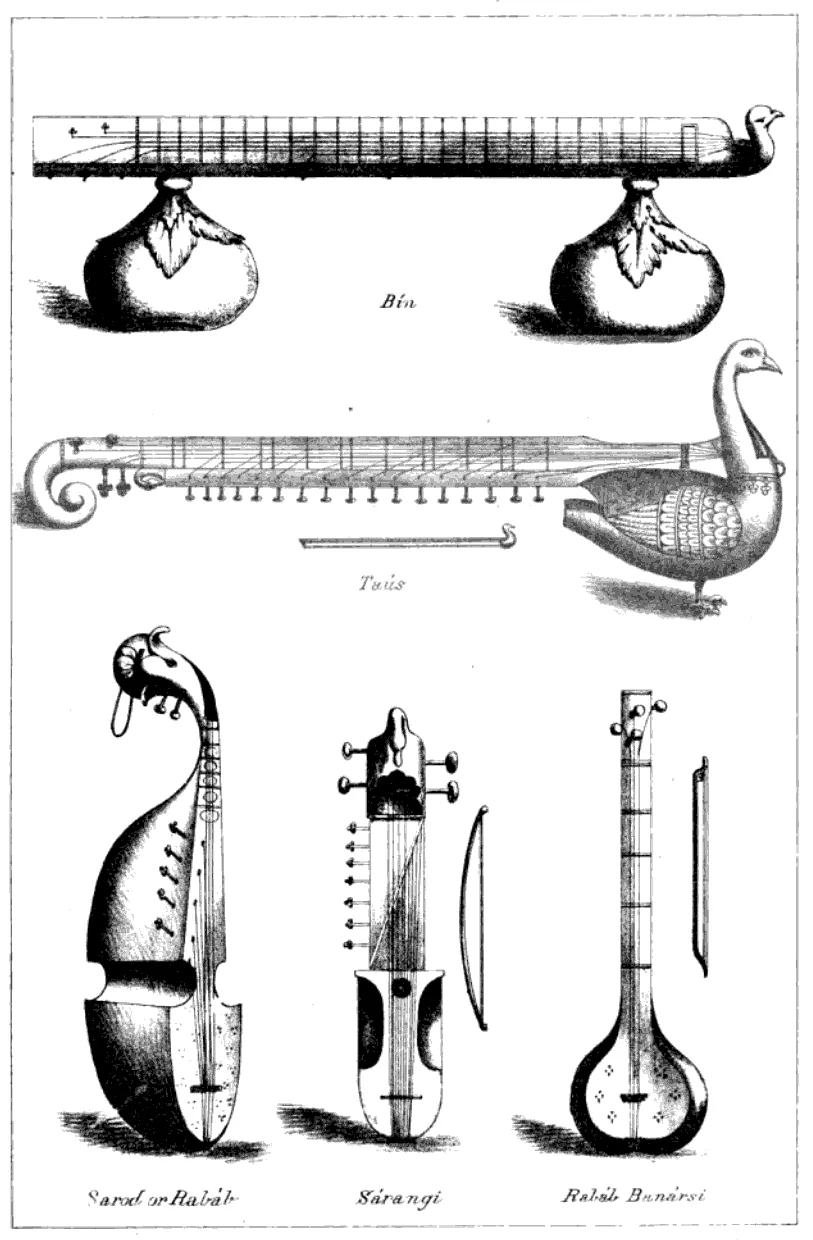
In the Mughal courts, adaptations are documented in Delhi from the eighteenth century onward: the aesthetic favored greater brightness. The wood, neck length and soundboard evolved to serve classical music.
Influences and standardization
These exchanges had two effects:
- the spread of forms and techniques along the Silk Road;
- standardization for court repertoire, evident in the eighteenth and nineteenth centuries.
The sitar thus appears in eighteenth-century records, while the sarod emerged in the nineteenth century as a hybrid of the rabab. These developments explain why construction, particularly the choice of wood and the presence of sympathetic strings, affects resonance and playing technique.
To learn more about forms and families, see this detailed guide to string instruments.
Indian lutes: how do the sitar, sarod and veena differ?
To identify an instrument at a glance, look for four key features. They provide a simple framework: whether it has frets and what kind, whether the soundboard is wood or skin, whether it is struck with a plectrum or the fingers, and whether it has sympathetic strings.
Quick visual guide:
- sitar: movable frets, a long neck and one or more resonators;
- sarod: a smooth metal fingerboard without frets and a skin-covered soundboard;
- veena: two resonators, fixed frets and a substantial South Indian body.
Quick listening guide: brightness and a “buzz” characterize the first; depth and slides define the second; a rounded tone and Carnatic articulation mark the third.
Form follows function: the choice of wood, gourd or skin changes resonance and shapes playing techniques. Understanding the body and soundboard helps you anticipate timbre and sustain.
The following sections profile each instrument (anatomy, strings and style), then offer a technical comparison. You will be better able to listen to them, recognize them and choose between them.
The sitar: anatomy, strings and resonance of North India’s iconic lute
The sitar is immediately recognizable by its elongated shape and bright timbre. Its large resonating body is often a gourd or a hemispherical block of wood. A small secondary resonator sometimes sits behind the neck.
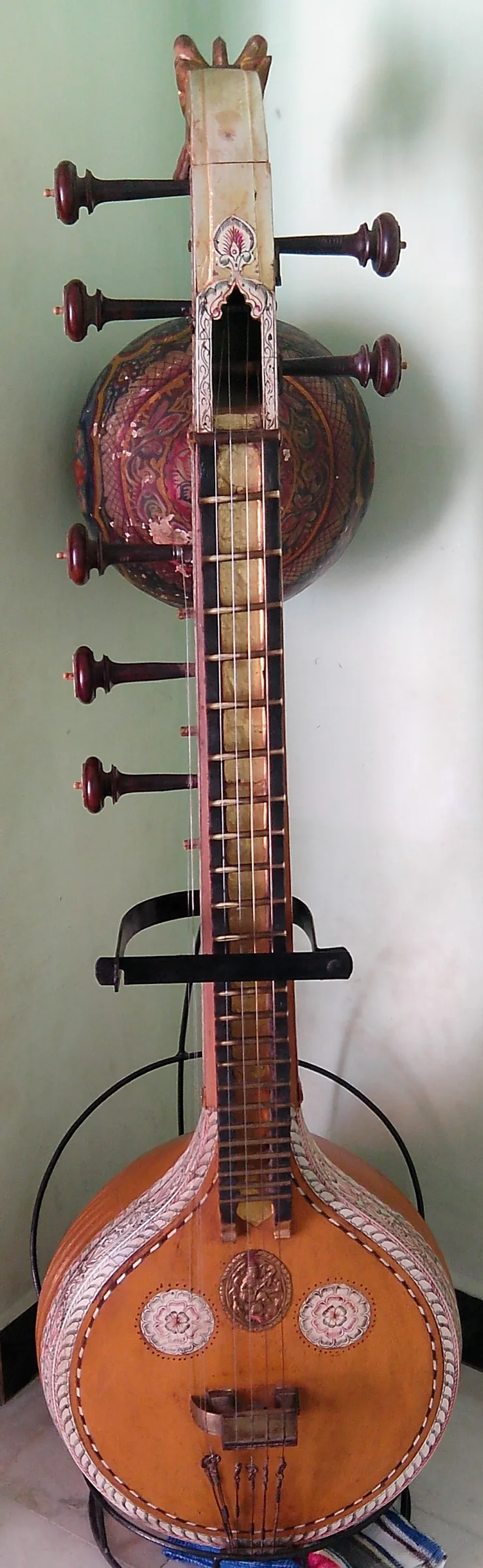
Body, hollow neck and materials
The hollow neck, carved from teak or tun wood, affects projection and tonal color. The choice of wood helps stabilize tuning and increase resonance.
Movable frets and bridge
There are 18 to 20 movable frets. They allow the intonation to be adjusted for each rāga. The bridge and soundboard create the famous “buzz” (jivari) that shapes the timbre.
Strings and playing technique
The strings are metal: 2 to 4 playing strings and 2 to 4 drone strings. Some versions also have sympathetic strings, which create a halo of overtones. The strings are struck with a metal plectrum for crisp, bright articulation.
Worldwide popularity
Ravi Shankar introduced the instrument to audiences beyond North India and helped make it a musical symbol recognized around the world.
Practical clue: movable frets + long neck + bright, sustained sound = very likely a sitar. To learn more about the string instrument family, see this dedicated guide.
The sarod: power, depth and fretless slides
The sarod stands out for its dark timbre and substantial attack. This North Indian lute emerged in the nineteenth century as a hybrid of the rabab. It is especially distinguished by the unusual continuity of its melodic line.

Body, soundboard and fingerboard
The body is carved from solid wood (mulberry or teak). The body is covered with skin, increasing projection and resonance.
The fingerboard has a smooth metal plate. This surface changes the attack and gives a denser sound than an instrument with an entirely wooden soundboard.
No frets: microintervals and meend
The complete absence of frets allows an uninterrupted slide (meend). Musicians can therefore play microintervals and create an almost vocal line.
Right-hand technique and strings
The right hand uses a java (a plectrum, often made of coconut shell) for a decisive attack. There are about 10 playing strings and about 15 sympathetic strings that enrich the texture, while the tone remains darker than that of other instruments.
“If an instrument has no frets, a skin soundboard and a metal fingerboard, it is probably a sarod.”
| Feature | Construction | Fingerboard | Sound |
|---|---|---|---|
| Distinctive features | Solid wood, skin-covered body | Smooth metal plate | Deep and continuous |
| Frets | None | Not applicable | Meend, microintervals |
| Strings | 10 playing strings + about 15 sympathetic strings | Interaction between metal and skin | Rich and dark |
To explore the context and other guides to Indian classical music, follow the link above.
The veena: a classical instrument and its regional variants
The veena holds a central place in South Indian classical music. This ancient lute takes several forms according to tradition and construction.
The Saraswati veena is the principal South Indian form: it combines a round wooden body (ebony or jackwood) about 30 cm across with a second gourd resonator. Its long neck carries 24 fixed frets. Its association with the goddess Saraswati strengthens its ritual and teaching roles.
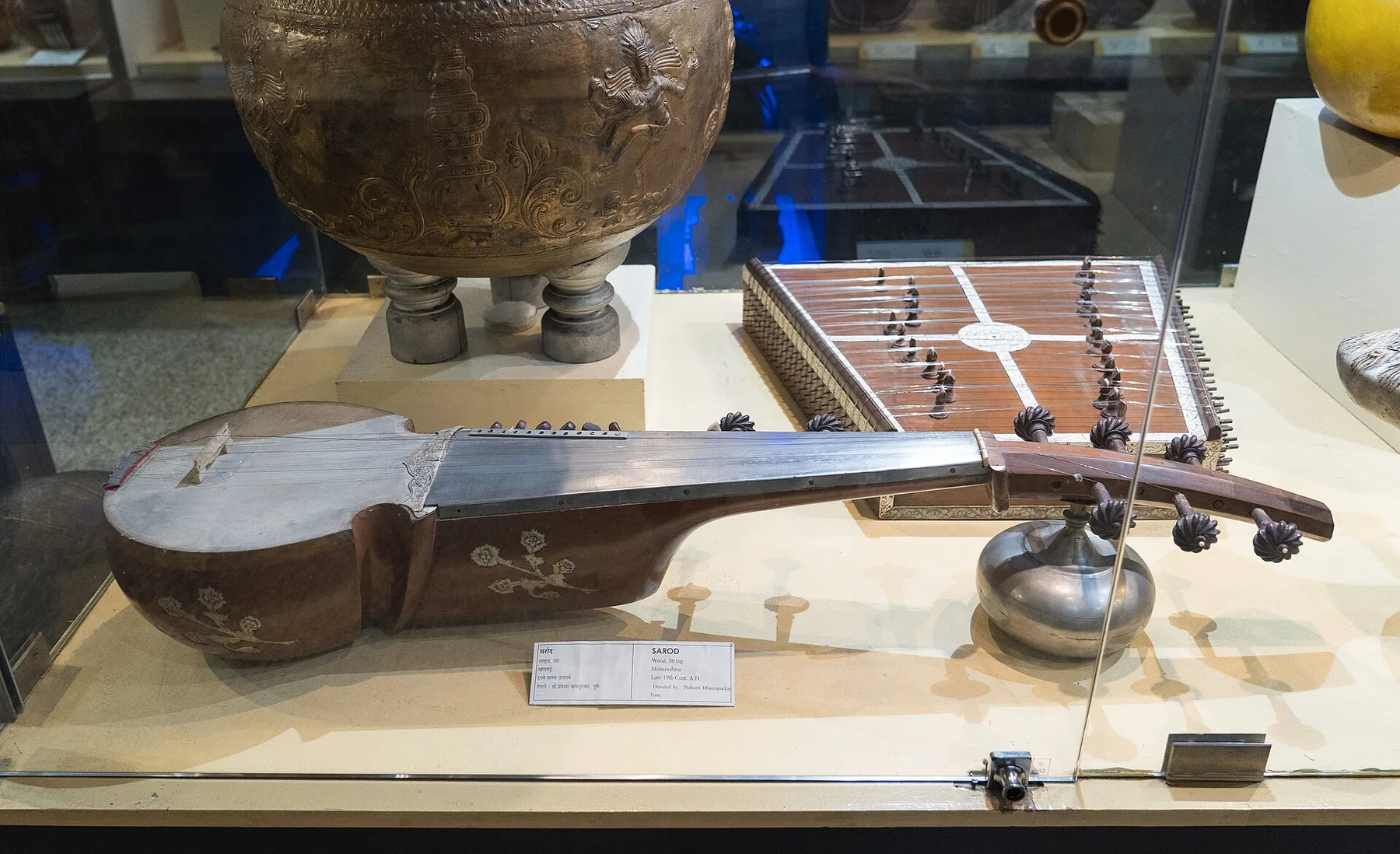
Materials, strings and recognition
The wooden body and gourd shape its resonance. The strings are made of steel and brass.
- Typical configuration: 7 strings, with 4 for melody and 3 for accompaniment and rhythm.
- Shape and neck: a large instrument played while seated, with an articulated, stable sound.
- Variants: the North Indian Rudra veena shares the name but can differ in construction and use.
Depicted since antiquity, the veena connects classical music to a long cultural tradition.
For a visual reference and comparisons, see this comparative guide.
Technical comparison: construction, playing technique and sound
This section connects construction to sound to help you identify an instrument quickly.
Resonating bodies and resonators
A resonating body made of wood or gourd changes brightness and projection.
A wooden body gives the sound warmth and fullness. A gourd brings more shimmer and carrying power. A skin soundboard strengthens the attack and depth.
Playing strings, drones and sympathetic strings
The playing strings determine articulation; drones provide a tonal foundation. Sympathetic strings create a halo and extend the sound.
The more strings there are, the denser and richer in overtones the sound seems.
With or without frets
Movable frets allow precise ornaments and targeted bends. Without frets, players can produce continuous slides and highly expressive microintervals.
Right hand and attack
The right hand shapes the attack: a metal plectrum produces a sharp, shimmering sound; the java gives a denser attack; and plucking with the fingers provides clear, classical articulation.
“Frets, soundboard material (skin or wood), type of attack and number of sympathetic strings: remember these four criteria to identify an instrument.”
If you like the sitar’s bright sound, choose an instrument with a gourd and metal plectrum. For depth and slides, look for a skin soundboard. For Carnatic articulation, favor a configuration with fixed frets. To explore further, see this guide to construction and styles.
Conclusion
In summary: remember three clues for quickly recognizing an instrument.
Sitar — movable frets, brightness and sometimes sympathetic strings; ideal for ornamented lines and a shimmering timbre.
Sarod — no frets, continuous slides and a skin soundboard: a deep, vocal sound that excels at meend.
Veena — a South Indian tradition, two resonators and fixed frets: a measured, articulate sound associated with solo and ritual roles.
These visual clues and the type of attack form a simple method: shape + musical role + playing technique = reliable identification.
To sharpen your ear, compare landmark recordings, particularly of the sitar, which became popular worldwide. You can also explore related instrumental approaches on Paul Grant’s page.
Conclusion: North and South India offer different but complementary musical aesthetics. Understanding each instrument’s role helps musicians and listeners better appreciate the richness of the repertoire and its performance.