
A common problem: in crosswords, a short clue can conceal several closely related instruments.
This article first gives the most likely answer to the clue, then explains why other forms exist.
We offer a quick solution for word games and reliable ways to distinguish each instrument by sight and sound.
The guide draws on dictionary definitions (Le Robert and Furetière) and features of instrument construction: neck, pegboxes and open strings.
Historical context: these instruments were used chiefly in the seventeenth century for basso continuo and accompaniment.
Glossary outline: definition, etymology, visual clues, tuning, historical context, comparisons and a short practical glossary.
For more background, see the reference article on the lute.
Large lute in six letters: how to recognize the variants
A brief clue often points to the Baroque instrument expected in the grid.
Why word games favor a single answer: clue writers choose a short, familiar name with an established place in culture. Le Robert defines the theorbo as a type of lute with a low sound, making it a reliable answer.
The “six letters” constraint explains why one particular term predominates. In French, THÉORBE fits the required length exactly, which accounts for its frequent appearance in grids.
Related historical names—chitarrone and tiorba—can nevertheless complicate identification. Depending on the time and place, these variants refer to forms of the same instrument.
Word games and musicological reality: one name could describe several models. Furetière (1690) describes a lute-shaped instrument with an extension for low notes, used in continuo.
Next, we suggest simple checks: look for two pegboxes and open bass strings, and consider the instrument’s accompanying role. The theorbo flourished especially in the seventeenth century, notably in opera and the continuo sections of Baroque ensembles.
Dictionary definitions of the theorbo
Glossary: the theorbo is an enlarged lute designed to extend the range downward.
Modern definition — Le Robert describes it as a type of lute with a low sound. This points to a lower register, a rounded tone and a frequent accompanying role.
Early definition (seventeenth century) — Furetière describes a lute-shaped instrument with two necks: the longer second neck carries courses of strings for lower notes.
“A lute-shaped instrument with two necks; the longer second neck carries the last courses of strings to produce lower notes.”
Historical use: these bass courses serve the basso continuo and support the voice in a Baroque ensemble. French spelling varied (téorbe / théorbe), as did the terminology for string courses.
| Source | Wording | Implication |
|---|---|---|
| Le Robert | A type of lute with a low sound | Low register, accompaniment |
| Furetière (1690) | A lute-shaped instrument with two necks | Open bass strings, basso continuo |
| Practical usage | French spellings: téorbe / théorbe | Visual and technical features to examine |
For examples of makers and instruments, consult this instrument record, which illustrates these features and leads into the section on visual clues.
Etymology and origin of the name “theorbo”
The word we use today preserves a borrowing from Italy. Furetière states plainly: “This word came from the Italian tiorba, meaning the same thing.”
The word tiorba appears as early as 1598 in John Florio’s work. It later coexists with spellings such as theorbo and téorbe.
- Borrowed word: Baroque instruments often retain their original names as they move between courts and theaters.
- Equivalent terms: tiorba and theorbo refer to the same family despite national differences in spelling.
- Timeline: late sixteenth century in Italy and England → spread to France in the seventeenth century.
“This word came from the Italian tiorba, meaning the same thing.”
Etymology does not, however, explain every technical distinction. Names such as chitarrone may describe closely related instruments or act as synonyms, depending on context.
Practical rule: treat “tiorba” as a clue to Italian origins when reading a score, description or catalog.
What does a theorbo look like? Visual clues for identification
A few details visible from a distance can often identify a theorbo. Start with its outline: an elongated body with a second neck distinctly longer than the first.
Two pegboxes and an extended neck
The most reliable visual check is the presence of two pegboxes, or two heads. The extension holds additional bass strings that do not run over the fingerboard.
Open bass strings
The term open strings means these bass strings are played without being stopped against the fingerboard. They vibrate at their tuned pitches and provide a deep bass without being fretted.
In a photograph, locate the fretted area (the fingerboard), then the section where the strings pass above the soundboard without being pressed against frets.
Body, rosettes and variations in shape
The body, the number and style of rosettes, and the choice of wood vary among makers and traditions. These differences do not change the key identifying features: pegboxes and open strings.
In practice, the longer neck produces deeper bass notes without requiring thicker strings. Stage photographs can make an archlute look similar, so consider the features together.
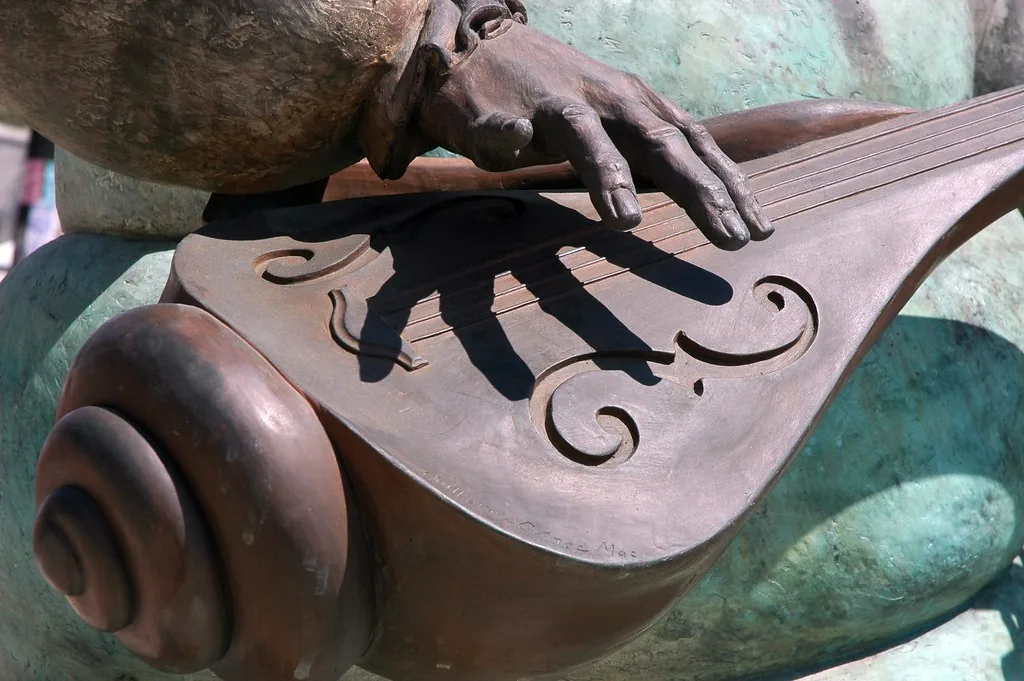
For more on setting up and selecting strings, see our guide to choosing strings, which helps explain the response and tone of stringed instruments.
What makes a lute “large”: range, bass strings and pitch standard
What sets an enlarged model apart is its ability to produce substantially lower notes.
Musical definition: “large” describes an instrument whose range extends below that of a standard lute.
Three practical reasons explain its deeper tone:
- Additional bass strings: extra strings provide notes unavailable on an ordinary instrument.
- Greater vibrating length: a longer string naturally produces a lower note.
- Resonant open strings: these strings vibrate freely and sustain resonance, reinforcing the low notes.
The pitch standard also matters. There was no single standard at the time: the chosen pitch varied by country, repertoire or ensemble.
A useful guide: the frequency of A above middle C often varied between 392 and 470 Hz. This range shows how the same instrument can sound higher or lower under different tuning standards.
In practice, the perceived bass depends on how the ensemble is tuned. Players adjust to voices, strings and continuo so the bass sits properly in the texture.
The next section explains how courses are arranged and how the gradual addition of strings further deepened the register.
Strings, courses and their arrangement on lutes
Understanding how strings are grouped helps when reading a photograph or an instrument description.
Courses and “two strings per course”: the general principle
A course (or string group) is a small group of strings, often played as one unit. On many historical instruments, a course has two strings tuned in unison or an octave apart, hence the phrase “two strings per course.”
The chanterelle and exceptions
The chanterelle is often a single high string. This exception affects the brightness of the tone and the melodic line.
Adding bass strings over time
A simple reference point: the standard Renaissance lute has six courses. Over time, makers added bass courses to extend its lower range.
The Baroque lute can have as many as thirteen courses. This increases the number of strings and makes their layout on the neck, as well as playing, more complex.
Practical note: the number of strings does not always equal the number of courses. Overlooking this distinction causes many errors in descriptions for general readers.
Tuning and playing: understanding the theorbo’s musical design
The theorbo’s balance of sound begins with simple but effective choices of tuning and playing technique.
Reentrant tuning and its effect
In reentrant tuning, the two highest strings are tuned somewhat lower. This sacrifices part of the instrument’s natural upper range.
In return, it offers greater harmonic continuity and easier accompaniment. The tone becomes less bright but more even.
Why open bass strings are favored
Open strings provide stable, resonant fundamental notes. They respond quickly and support the bass line.
Because some bass strings cannot be fretted, playing technique naturally uses these open strings to sustain the sound.
Common use: accompaniment and basso continuo
The theorbo is used mainly for continuo, accompanying voices and ensembles with instruments such as viols, cellos and harpsichords. It adds definition and color without drowning out the others.
Compared with the lute, it has very little solo repertoire; the literature favors accompaniment.
- What to listen for: a rounder tone, audible bass notes and less brilliant high notes.
- How its shape affects playing: open strings and a long neck favor accompaniment.
Historical context: the theorbo’s rise in the seventeenth century
By the mid-seventeenth century, an instrumental model spreading from Italy was changing accompaniment. Developed to strengthen the bass, it met a new need in opera and chamber music.
Emergence and spread. The Italian name tiorba circulated from the late sixteenth century. Around 1650, the practice reached France, where it quickly entered court and theater repertoires.
Role in ensembles
Continuo and support for voices: players positioned the instrument near singers to reinforce the bass and clarify the harmony.
It often accompanied the viola da gamba or cello. Together, they supplied rhythmic definition and depth of sound.
| Setting | Function | Examples |
|---|---|---|
| Opera and theater | Provide basso continuo and support the voice | Overtures, recitatives |
| Salons and chamber music | Refined accompaniment and harmonic bass | Cantatas, chamber airs |
| Chapels and liturgical ensembles | Subtle support and a fuller sound | PSA, choral accompaniment |
Sizes and names varied with region and repertoire. This diversity of instrument forms helps explain today’s confusion with other instruments of the period.
For more background, consult this musician’s profile covering research and performance on these instruments.
Do not confuse it with the Renaissance lute
A quick look at the outline and fingerboard is often enough to distinguish a Renaissance instrument from an enlarged continuo instrument.
The Western lute: a fretted instrument for polyphony
The Western lute is designed for polyphony. Its fretted fingerboard allows precise sequences of chords and counterpoint.
Players pluck the strings to create complex harmonic textures. Its solo role also distinguishes its musical function.
The six-course Renaissance lute: a point of comparison
“Six courses” is a useful guide. An instrument with six courses is often a standard Renaissance model.
Look also for a rounded, ribbed back, a soundboard of resonant wood (often spruce) and carved rosettes. These features confirm the traditional form.
Quick check: one pegbox and strings that can all be played on the fingerboard suggest a Renaissance lute. Two pegboxes and open bass strings suggest a theorbo or archlute.
In short, the theorbo derives structurally from the lute, but its open bass strings change how it is played and the role it fills.
Do not confuse it with the Baroque lute
A large number of strings can be misleading. Some Baroque instruments evolved to serve more demanding repertoire.
More courses and more complex tuning
During the seventeenth century, the lute gained additional courses, sometimes reaching thirteen. This greater number extended the bass without radically changing the outline.
Tuning systems also became more complex. Some traditions, especially in France, adopted specific tunings to make playing in certain keys easier.
Why it can resemble an enlarged instrument
Visually, many strings suggest an instrument with an extended low range. Yet the essential structural difference concerns the pegbox.
The Baroque lute generally retains a single pegbox. The theorbo has a second set of tuning pegs and open bass strings. Count the heads and check whether the bass strings can be fretted; this matters more than the number of strings alone.
| Feature | Baroque lute | Instrument with open bass strings |
|---|---|---|
| Number of courses | Up to 13 | Varies |
| Pegboxes | One | Two (visible extension) |
| Bass strings played on the fingerboard | Often yes | Often no (open strings) |
| Effect on repertoire | Specialized tunings | Greater role in continuo |
In practice, the confusion usually comes from blurry photographs and imprecise terminology. Counting pegboxes and checking whether the bass strings are fretted quickly helps distinguish these instruments.
Archlute: the closest variant and why it causes confusion
Visually similar to the theorbo, the archlute uses an extension for bass strings while remaining closer to the traditional lute in handling.
It often has two pegboxes, enough to mislead an observer at a distance. Its tuning and the length of its second neck, however, can differ.
Two pegboxes and overall shape
The archlute has an elongated outline but is less massive. Its bass strings may be open, while the body retains proportions closer to those of a lute.
The key difference
As a general rule, the archlute does not use reentrant tuning. Its upper notes remain more usable, and its range sounds brighter.
Use in continuo
It provides support when the theorbo’s power is unnecessary. It serves in chamber music continuo when a cello or viol supplies the bass.
Practical method: combine observation (the second neck’s length and the presence of open strings), listening (more prominent high notes) and historical context to decide.
| Criterion | Archlute | Theorbo |
|---|---|---|
| Pegboxes | Often two | Two (prominent) |
| Reentrant tuning | Generally no | Common |
| Handling | More agile | Less manageable |
| Common use | Chamber music continuo | Continuo, opera, ensembles |
Chitarrone: “large guitar” or Roman theorbo?
Older descriptions often use chitarrone for a “large guitar” in the Roman tradition. The name points to a geographical origin more than to an entirely separate instrument.
Historically, the term describes an Italian style from the early Baroque period. In many cases, it refers to the same family as the theorbo.
Practical rule: if an instrument has two pegboxes and open bass strings, it belongs to the theorbo and chitarrone family. The name on a program often signals a Roman character in the repertoire.
Take care with modern usage: some album covers use chitarrone to evoke an earlier period even when the instrument looks more like an archlute. Check its outline and musical role before interpreting the name.
| Criterion | Interpretation | Practical implication |
|---|---|---|
| Name | Historical / geographical | The name offers a stylistic clue |
| Structure | May have two pegboxes | Close to the theorbo |
| Use | Baroque repertoire, continuo | Editorial choice in programs |
Tiorbino: the “small theorbo” and its uses
The tiorbino brings a lighter shade to the Baroque register. This miniature instrument is often played with a larger one to create a contrast in range.
Definition: the tiorbino is a higher-pitched version of the theorbo, intended to double upper parts or converse in duets. It favors melodic agility over an extremely low register.
The apparent paradox: while the theorbo enriches the bass, the tiorbino complements the texture. Its tone can approach that of a lute and bring out high voices.
A documented example: Bellerofonte Castaldi wrote pieces in which a large instrument and a tiorbino answer each other. Such works are found mainly in the first decades of the seventeenth century.
Identification tip: do not rely on the word “theorbo” alone in a description. Check the size, stated range and role in the ensemble. For an accessible account, see this museum description.
| Criterion | Tiorbino | Theorbo |
|---|---|---|
| Role | Double upper parts, play in duets | Provide basso continuo |
| Tone | Clear, close to a lute | Deep, resonant foundation |
| Settings | Early Italian Baroque repertoire | Opera, continuo, ensembles |
Quick clues for distinguishing a theorbo, archlute, lute and guitar
A focused three-step examination is often enough to tell them apart. The method combines looking and listening.
Neck and pegboxes: the most reliable check by eye
Step 1 — Look at the neck. An extension with a second head indicates an enlarged instrument.
One pegbox points more toward a Renaissance instrument. Two pegboxes suggest a theorbo or archlute.
Fingerboard and fretted or open strings
Step 2 — Check whether the bass strings run over the fingerboard. If they do not, they are open strings, and the instrument belongs to the theorbo family.
On a historical lute, there are often two strings per course. A modern guitar has single strings, which are easy to spot.
Tone and musical role: solo, polyphony, accompaniment
Step 3 — Listen: rounded bass notes and a continuo role suggest a large instrument. Dense polyphony and solo playing point toward the lute.
| Clue | Observation | Interpretation |
|---|---|---|
| Pegboxes | One | More likely a lute |
| Pegboxes | Two | Theorbo / archlute |
| Bass strings | Open strings (not running over the fingerboard) | Theorbo family |
| Strings | Two strings per course | A feature of historical instruments |
| Body | Flat, with six single strings | Modern guitar |
A simple guide: two pegboxes and open bass strings indicate a theorbo or archlute; one pegbox, frets and polyphonic playing indicate a lute; a flat body and six single strings indicate a guitar.
Glossary terms for reading an article or tablature
Understanding technical terms helps identify an instrument in a photograph or program. This short glossary gives brief definitions and visual clues.
Neck, fingerboard, body, bridge: anatomy
Neck: the long support carrying the fingerboard and frets.
Fingerboard: the surface where fingers press strings to fret notes.
Body: the wooden resonator that amplifies the sound.
Bridge: the point where the strings are anchored to the soundboard.
Courses, chanterelle, bass strings and open strings
Courses or string groups: pairs of strings often played together.
Chanterelle: the highest string, often a single string.
Bass notes: low notes. Unstopped strings or open strings vibrate without being fretted.
Tuning, pitch standard, repertoire: musical terms
Tuning: the arrangement of the strings’ pitches for playing. The pitch standard is a reference pitch that varies by period and ensemble.
In a description, lute, theorbo or archlute may be broad labels or identify a specific historical choice.
| Term | Meaning | Clue in a photograph |
|---|---|---|
| Neck | Support for the fingerboard | Visible extension toward the head |
| Body | Resonant wooden body | Rounded or flat back, rosette |
| Open strings | Unfretted bass strings | Pass above the fingerboard without being pressed down |
Comparison for general readers: the classical guitar has a flat body and single strings. Lute-family instruments have ribbed backs and rosettes, and often two strings per course.
A glossary also helps connect an instrument’s anatomy, playing technique and musical role.
Conclusion
In summary, the most likely French crossword answer is théorbe. It is the typical “large lute” because it produces lower notes, and its French name has six letters.
Quick ways to identify it are two visible pegboxes, open (unfretted) bass strings, and a frequent role in basso continuo. Together, these three signs provide the main visual and audible clues.
Avoid confusion: the Renaissance lute often has six courses; the Baroque lute can have many without necessarily having open bass strings. The archlute remains similar, but its tuning and handling differ.
Context matters: the repertoire, ensemble and century help explain why one name covers several forms. To check, look at the pegboxes, find the open strings, then consider the music and the instrument’s function.
This glossary will help you answer a crossword clue quickly and then recognize the instrument in a photograph, at a concert or in recording notes.