
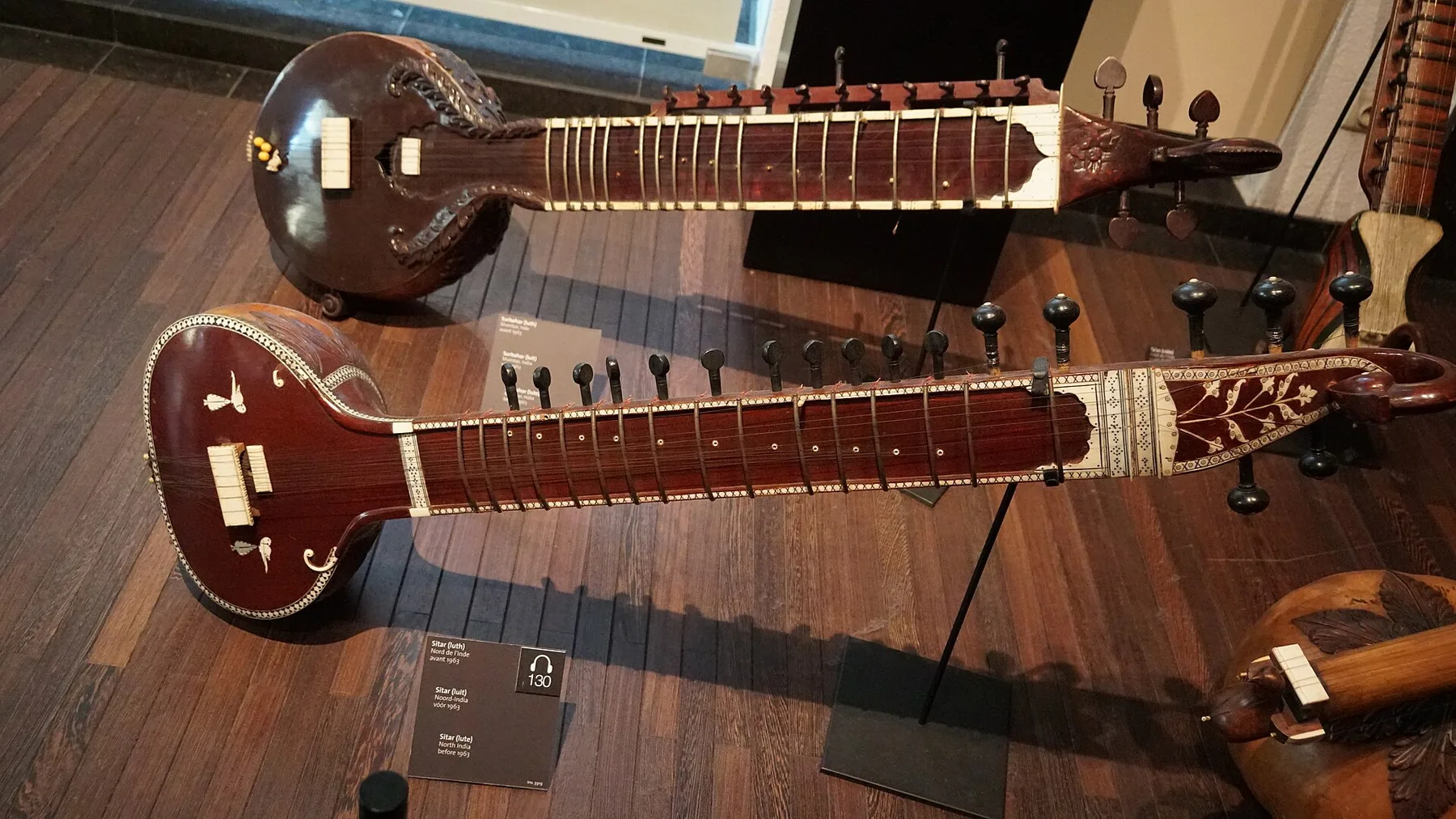
Introduction — This article introduces a family of instruments at the heart of the Indian subcontinent, renowned for their resonance, timbre and place in classical and popular music.
Why are these instruments so captivating? Their deep sound, playing techniques and central place in raga make them distinctive on the world stage.
We will connect their construction (neck, soundboard and bridges) with cultural practices (raga and teaching from master to disciple).
The historical journey runs from the Silk Road and Persian and Middle Eastern influences to royal courts and international stages. This perspective helps English-speaking readers place this heritage in context.
Finally, this guide will help you identify the sitar, sarod, veena, surbahar, tanpura and swarmandal, and understand their technical and musical roles. For a closer look at the instruments, see this article on those of the subcontinent.
See an overview of the main instruments
Understanding Indian lutes and their place in Indian music
A plucked string instrument produces sound when a string is plucked with a finger or plectrum. Its resonating body amplifies the sound, giving it sustain and resonance.
What is a plucked string instrument in Indian music?
These instruments occupy a central place in Hindustani and Carnatic classical music. They are used for solo performance, ritual accompaniment and teaching from master to disciple.
Between technique and spirituality
The veena, associated with Saraswati, symbolizes knowledge and the arts. Practising raga combines technical discipline with a spiritual dimension: listening, memory and dedication.
A range of sounds and the role of accompaniment
Plucked strings offer a clear attack, sustained notes and resonance enriched by sympathetic strings. The tanpura supplies the drone; together, the tabla and drone provide the essential sonic setting for a raga.
| Feature | Example | Impression |
|---|---|---|
| Timbre | Sitar / sarod | Metallic or deep |
| Resonance | Tanpura | Steady drone |
| Ornamentation | Veena | Vocal quality associated with knowledge |
We will examine the physical features (body, neck and strings) before comparing the principal instruments.
Indian lutes: plucked string instruments and traditions
You can recognize a lute from the subcontinent by three simple features: a resonating body, a long neck and plucked strings. These elements provide an organological basis for understanding its sound and playing technique.
What sets it apart: body, neck and strings
The body may be a hollowed gourd or a block of wood. Its shape affects projection and sustain. A long neck allows a wide range of slides and ornamentation.
The distance between the bridge and nut, along with the stiffness of the neck, affects sustain. String thickness changes the dynamics and tone colour.
Shapes and depictions: stick zithers and other instruments
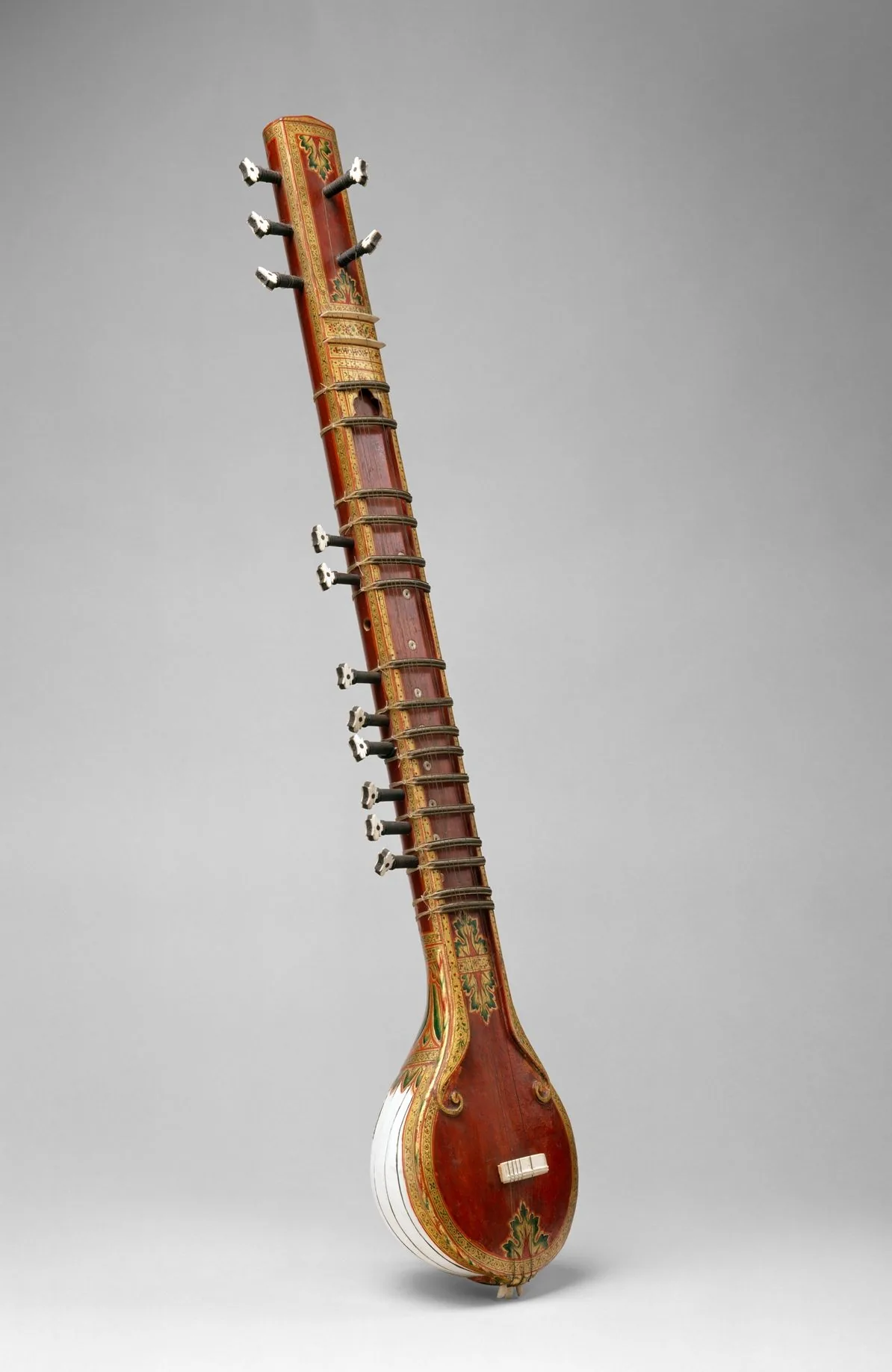
There are various forms: the sitar’s hemispherical body, gourd resonators and the tube-like structure of the rudra veena, a zither with two gourds. Early depictions show that acoustic principles have endured despite the diversity of forms.
It is useful to distinguish the organological meaning of “lute” from that of a stick zither. The next section traces the historical origins and exchanges that shaped these instruments.
Origins and history: from the Silk Road to royal courts
Trade routes shaped the emergence and spread of the instruments we know today.
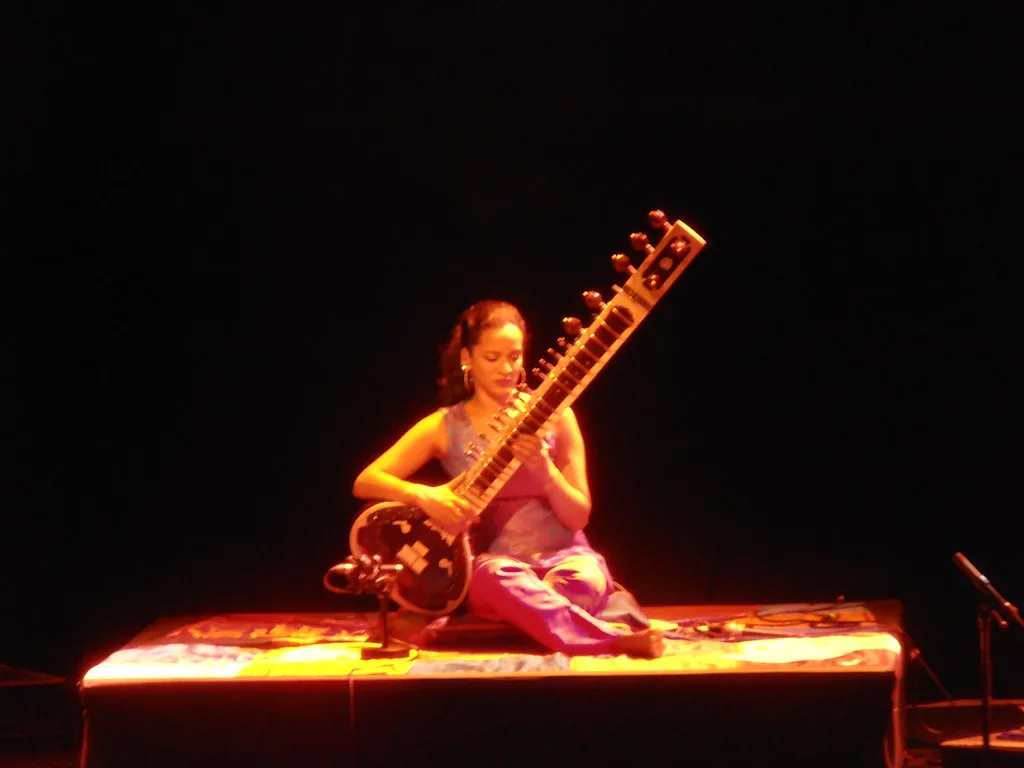
The earliest traces date to the third century BCE, in Greco-Buddhist stone carvings depicting musicians and string instruments. This archaeological evidence points to a long-standing practice that continued through the centuries.
Persian and Middle Eastern influences
From the early Middle Ages onward, instruments such as the barbat, oud and setar circulated. Makers adapted materials, frets and tunings to local tastes.
The Mughal period intensified these exchanges. At royal courts, patronage encouraged standardization and the emergence of established repertoires.
Evolution and the movement of musicians
Medieval developments led to more detailed documentation in the eighteenth century, when the sitar appeared in accounts from Delhi.
Travelling musicians crossed regions and borders, passing on techniques and styles. Their movement also helps explain adaptations for transport and performance.
This history can still be read in the anatomy of the instruments: their bodies, necks and bridges bear traces of innovations such as the addition of sympathetic strings.
Instrument anatomy: body, neck, soundboard and fingerboard
Examining the anatomy reveals how each part affects sound and playing technique.
The instrument’s components: the body amplifies sound, the soundboard transmits vibrations, the neck guides pitch, the fingerboard receives the fingers, and the bridge transfers vibrations to the body.
The body may be a hollowed gourd or a block of wood. Its shape and volume influence projection and warmth.
The soundboard acts as a vibrating membrane. On some instruments, such as the sarod, it is covered with a thin skin to produce a darker timbre.
The neck varies in length and stiffness. A short, sturdy neck helps keep the tuning stable. A long neck allows extended slides.
The fingerboard may be smooth metal for continuous slides, or it may have fixed or movable frets. The position of the bridge affects attack and sustain.
Jawari and the halo of sound: a silk thread placed near the bridge creates the jawari effect. This small element produces the characteristic buzz that enriches the harmonics.
Having examined the anatomy, we will turn to the strings, their metals and their tunings.
| Component | Common materials | Acoustic effect |
|---|---|---|
| Body | Gourd, teak, tun, jackwood | Projection, warmth, resonance |
| Soundboard | Wood or skin | Attack, tone colour |
| Neck | Teak, mulberry, tun | Stability, slides |
| Bridge / jawari | Wood, silk thread | Buzz, halo of harmonics |
Strings, metal and tuning: how the notes take shape
Sound takes shape as each string resonates according to its purpose. Three groups of strings coexist: melody strings, drone strings and sympathetic strings.
Melody, drone and sympathetic strings
Melody strings are few in number and carry the tune. Drone strings provide a continuous, steady sound. Sympathetic strings, often numerous (sometimes more than 15), add rich harmonic resonance.
Materials and the effect of metal
Metal (steel or brass) emphasizes attack, brightness and sustain. Some instruments combine metal strings and nylon to balance warmth and projection.
Tuning, subtle pitch differences and technique
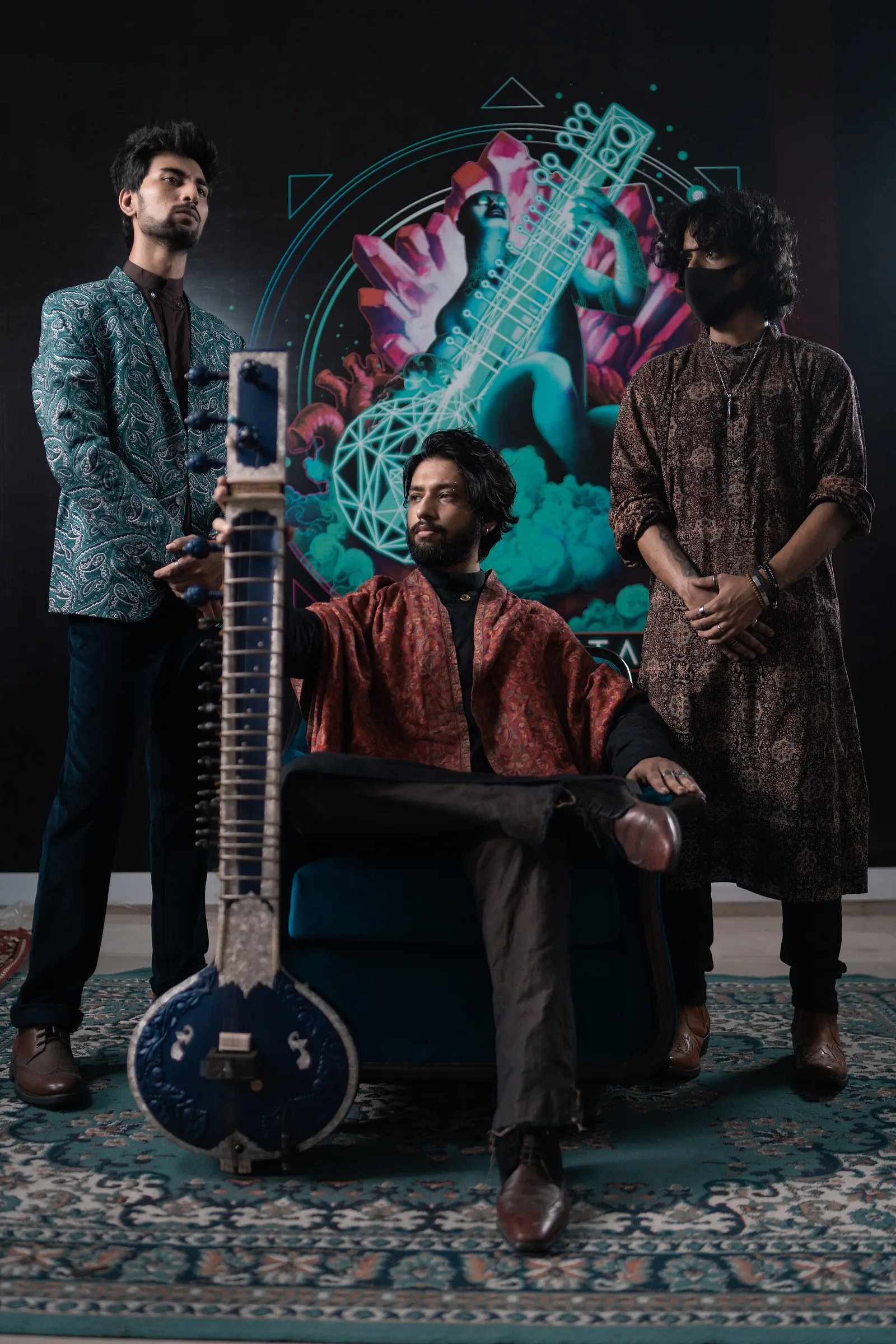
Sa-Pa-Sa tuning, based on the fifth and octave, often serves as a modal reference. Musicians train their ears to hear shrutis, the subtle pitch intervals that shade each phrase.
The plectrum changes the tone: a metal mizrab for the sitar, a coconut-shell java for the sarod, or direct playing with the fingers. A slide (meend) turns a single note into a vocal phrase. With these points in mind, it becomes easier to recognize the sitar, sarod or veena.
The main types of Indian lutes to know
Here is an overview of the essential instruments, each suited to a particular musical purpose. Each has its own sound and role: solo playing, drone or vocal accompaniment.
The sitar
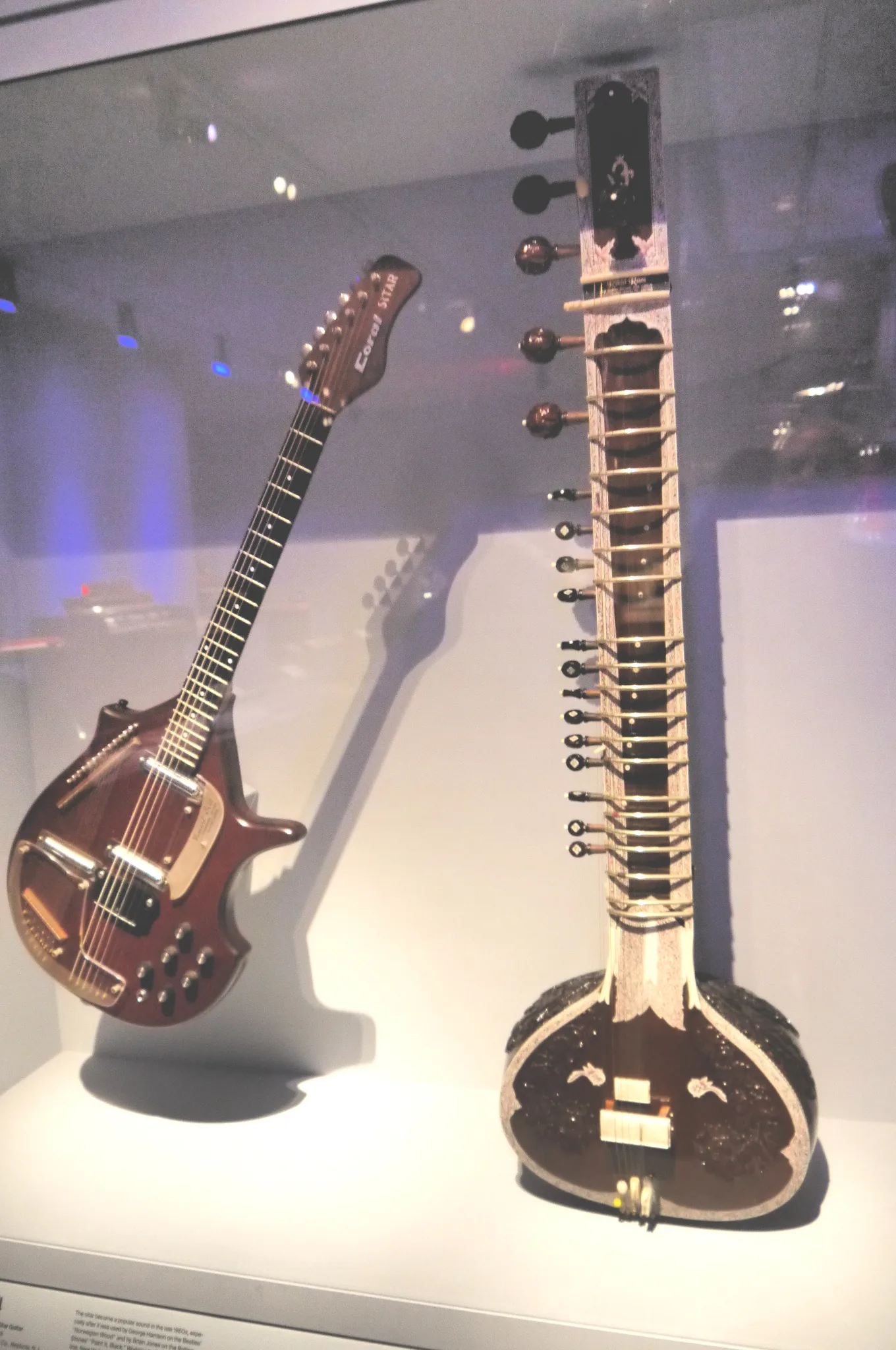
Sitar: a long neck, movable frets and many sympathetic strings. Playing with a mizrab creates a singing tone that made the instrument famous beyond the subcontinent, thanks to Ravi Shankar and the Beatles’ interest in it.
The sarod
Sarod: a smooth metal fingerboard without frets. Its deep tone and continuous meend recall its historical connection with the Afghan rabab. Ali Akbar Khan brought it to international audiences.
The veena
The Saraswati veena (South) and rudra veena (North) embody a long tradition. They carry symbolism associated with knowledge and have two visible resonators.
Surbahar, swarmandal and tanpura
The surbahar is a bass sitar suited to exploring low registers and extended alaps.
The swarmandal is an accompanying zither whose groups of notes add colour to the modal setting.
The tanpura supplies the drone, tuned to the reference notes of the raga. It remains indispensable and is sometimes joined by an electronic version in concert.
North and South: regional traditions and musical schools
North and South have distinct musical aesthetics. In the North, performers favour the sitar and sarod, supported by tabla and tanpura. Playing emphasizes extended improvisation and slides.
In the South, the Carnatic tradition values the veena and instrumental interpretations of vocal forms. Pieces often follow a tightly structured rhythmic framework and established compositions.
Hindustani and Carnatic music: sound and instrumental roles
The Northern tradition favours a long alap followed by faster sections. Musicians explore tone colours and flexible forms.
The Southern tradition brings together singing and composition. Rhythmic forms are more prominent, and the veena plays a central role.
Related variations and neighbouring instruments
Bowed instruments offer another way to sustain sound. The voice-like sarangi first accompanied singing before becoming a solo instrument.
The esraj and dilruba both have fretted necks and sympathetic strings, but are associated with different regions (Bengal and Punjab).
The rabab, of Afghan origin, sheds light on the development of the modern sarod and historical exchanges among musicians.
The lute in Indian classical music: raga, time and emotion
The framework of a raga shapes every performance, from its opening notes to its virtuosic peak. It defines a musical time and emotional character, guiding the musician through the piece.
Structure of an instrumental raga: alap, jor and jhala
The alap begins in silence and at a slow pace. The musician explores the notes, lets the harmonics ring and establishes the modal world.
The jor introduces a pulse without percussion. The playing gains momentum and movement.
The jhala concludes with fast, brilliant figures. It reveals the musician’s virtuosity and expressive intensity.
Ornamentation and expression: meend, inflections and the instrument’s “voice”
Ornaments (meend, inflections and vibrato) bring a phrase close to the human voice. The musician’s playing shapes each note to produce singing sounds.
Accompaniment: the tabla and the tanpura’s drone
The tabla enters after the alap to organize the rhythmic cycle. Its role is a dialogue that goes beyond marking the beat.
The tanpura supplies the drone: it steadies intonation and provides a reference for the notes.
“Listen to an alap by Ravi Shankar, then a jhala by Vilayat Khan: the progression becomes clear.”
Learning requires stamina, technique and instruction. Aspiring musicians work on movement, patience and memory to do justice to this form.
Playing techniques and traditional learning
Good sound begins with a stable seated position and well-coordinated hands.
Posture and preventing fatigue
A stable torso: sit upright but relaxed. Position the neck so that the weight is distributed without straining your wrist.
Relax your neck and shoulders to play long pieces. Regular breaks reduce the risk of injury.
Right and left hands: precision and stamina
The right hand controls the attack, with a plectrum or the fingers. Develop clear resonance through slow exercises.
The left hand shapes meend and subtle pitch differences. Practise slow scales to build the stamina needed for a complete raga.
Frets, fretless playing and shrutis
Movable frets (sitar): adjust them to refine intonation. No frets (sarod): the left hand controls pitch directly.
Mastering shrutis requires practice against a drone. Repeat slowly, listen and correct each note.
Teaching from master to disciple and musical styles
Training extends over years. Sessions combine demonstration, imitation and memorization of key phrases.
The gharana influences ornamentation, rhythmic density and the clarity of phrases. Each school preserves its own aesthetic.
In France today, workshops, schools and lessons with visiting masters are available. Listening to landmark recordings helps train the ear.
| Aspect | Approach | Goal |
|---|---|---|
| Posture | Upright seated position, stable neck | Stamina and consistent sound |
| Right hand | Controlled attack (plectrum or fingers) | Clear resonance |
| Left hand | Slides and intonation | Control of shrutis |
| Teaching | Lessons, repetition, memorization | A repertoire built over years |
Listening to the masters remains invaluable for anyone studying this instrument.
Handcrafted instruments: wood, skin, decoration and skill
In instrument making, the choice of materials and the maker’s skill shape the sounding body. The maker balances strength and delicacy to achieve projection, sustain and jawari.
Choosing materials
Neck: teak or tun provides stiffness and stability. These woods withstand string tension without warping.
Body: mulberry and jackwood colour the tone. The material influences warmth and the body’s durability.
Gourd: light and resonant, it helps projection but remains sensitive to moisture.
Skin and soundboard
On the sarod, skin (goat or gazelle) covers the soundboard. It gives the instrument a clear attack and warm sound.
A rigid soundboard responds differently depending on whether it is played with a plectrum or finger. This choice changes how the sound develops.
Decoration and symbols
Peacock or lotus inlays tell a story about the workshop’s origins. They mark the object’s status and the maker’s region.
Workshops, climate and buying advice
Modern workshops adapt finishes, adjustments and joints to withstand travel and changes in temperature.
Before buying, check that the tuning pegs are stable, inspect the body and soundboard, and make sure there is no unusual tension in the instrument’s body.
For a historical comparison of soundboards and necks, see this article on the development of guitars and related instruments: history and development.
From cultural heritage to the world stage: influences and contemporary developments
Media exposure has made this timbre instantly recognizable around the world.
International popularity
Ravi Shankar played a decisive role in the 1960s. His collaboration with George Harrison and the Beatles’ interest stirred considerable curiosity in Europe, including France.
Tours, festivals and recordings established the sound’s worldwide reputation.
Notable performers
Vilayat Khan and Nikhil Banerjee shaped the sitar’s sound through their phrasing. Ali Akbar Khan brought the sarod to audiences beyond the subcontinent.
Innovation and the modern stage
Amplification, pickups and electric models now allow the sound to carry better on large stages.
Instrument makers also use new materials to stabilize adjustments and make transport easier.
Preservation and continuity
Sound archives, conservatories and the collection of recordings help safeguard repertoires.
To learn about safeguarding efforts, see the page on heritage preservation.
| Aspect | Development | Effect |
|---|---|---|
| Media exposure | International tours, recordings | Worldwide recognition |
| Technology | Amplification, pickups | Better projection on stage |
| Preservation | Archives, teaching | Continuity of repertoires |
Conclusion
In summary, the lute is characterized by its body, neck and plucked strings. These features give rise to families with recognizable sounds and distinct uses.
Its cultural value remains immense: a classical heritage, symbols associated with Saraswati and a demanding teaching tradition that endures. Historical exchanges and differences between North and South help explain variations in form and style.
To tell the sitar, sarod and veena apart, look at the frets, fingerboard and how the strings are plucked. Listen to an alap followed by a jhala, with the tanpura’s drone and the tabla, to hear the structure of a raga.
Now try it: choose an instrument, listen to a landmark recording and examine how its body is made to connect the theory with what you hear.