

The oldest and rarest string instruments are true treasures of instrument making and highlights of historic instrument collections. They are an important part of our musical heritage and are cherished by music lovers around the world. In this article, we will explore some of these instruments, their history and their rarity.
Among musical instruments, string instruments hold a special place. Their meticulous construction and captivating sound make them unique. The renowned instrument makers who created these remarkable chordophones left behind musical antiques that continue to delight music lovers today.
On this journey through the centuries, we will discover historic string instruments, musical rarities that have stood the test of time. We will explore their origins, their development over the centuries and the hidden treasures they contain.
Whether you are passionate about music history, collect instruments or are simply curious about unusual string instruments, this article will take you into a fascinating world where music and history meet.
Bowed string instruments
Bowed string instruments are instruments whose strings the musician sets vibrating with a bow. In Western classical music, the most commonly used bowed string instruments are the violin, viola, cello and double bass. These instruments have been part of the symphony orchestra since around 1778.
Besides these, there are other bowed string instruments, often used in Baroque music, such as the arpeggione, baryton, lirone, huqin, pochette, quinton, morin khuur, rebec, piccolo violin, viola all’inglese, viola pomposa or violoncello da spalla, violoncello piccolo, viola da gamba, viola d’amore, viol of Orpheus and violone.
The hurdy-gurdy is a distinctive bowed string instrument: its strings are rubbed by a wheel turned with a crank.
Bowed string instruments play an essential role in classical and Baroque music, bringing beauty and depth to compositions. The violin, in particular, is known for its expressive sound and its ability to convey the full range of human emotions.
Plucked string instruments
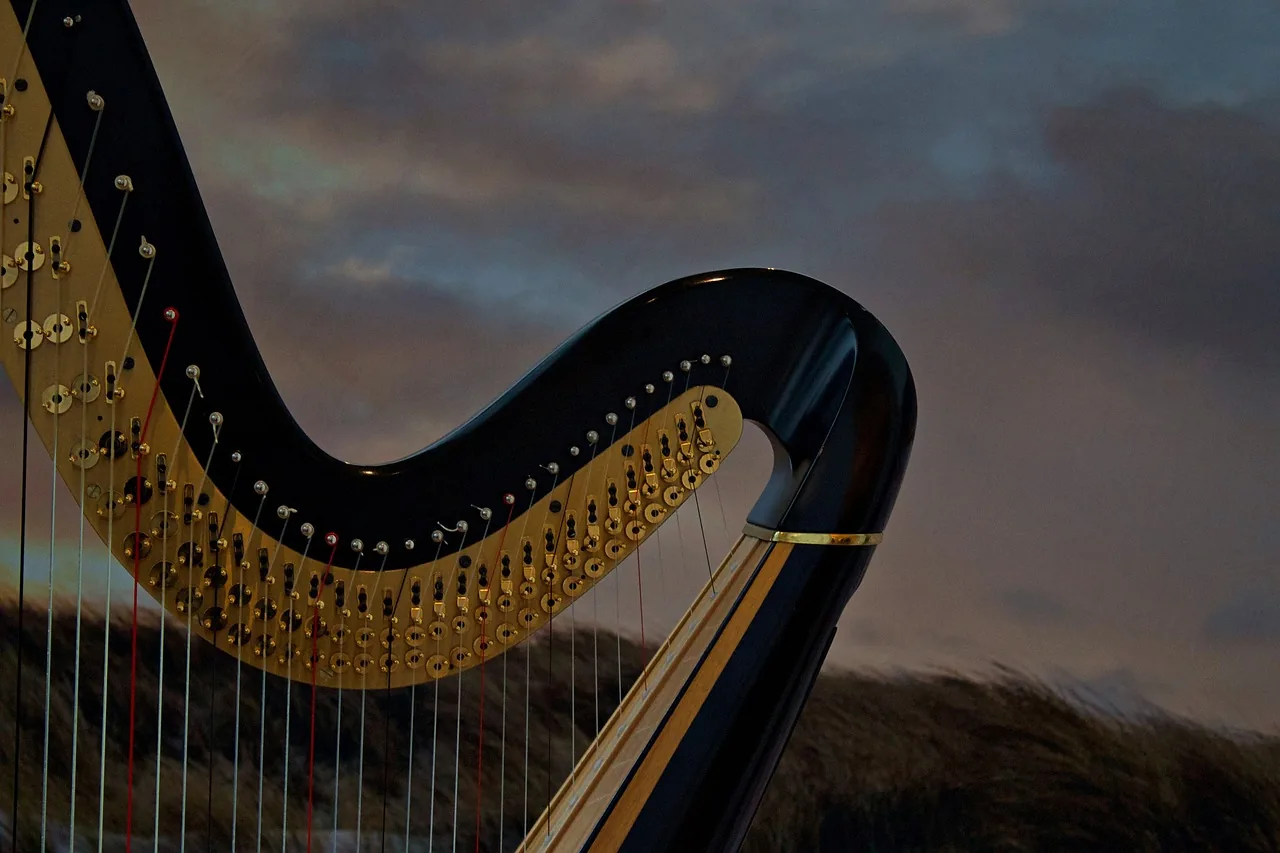
Plucked string instruments are instruments whose strings the musician plucks or strums with the fingers or a plectrum. They include the classical guitar, harp (especially from the Classical period onward), Baroque guitar, lute, theorbo, mandolin and bandurria. These instruments are often used in Baroque music.
Examples of plucked string instruments:
- Classical guitar
- Harp
- Baroque guitar
- Lute
- Theorbo
- Mandolin
- Bandurria
These plucked string instruments let musicians produce rich, melodious sounds by playing the strings in different ways. From the gentle sound of the classical guitar to the complexity of the harp, they offer a varied and expressive range of tones. Whether accompanying other instruments or played solo, plucked string instruments bring a distinctive quality to music.
Struck string instruments
Struck string instruments are instruments whose strings the musician strikes to produce sound. They include the pianoforte, piano, cimbalom, hammered dulcimer and string drum.
The piano is one of the most popular and widely used struck string instruments. This versatile instrument produces sound when hammers strike its strings as the player presses the keyboard’s keys. It is valued for its wide tonal range, expressive dynamics and rich sound.
The cimbalom is a struck string instrument traditionally used in Hungarian folk and classical music. It consists of a flat soundboard over which metal strings are stretched. The musician uses two mallets to strike the strings and produce melodic, percussive sounds.
The hammered dulcimer is a struck string instrument popular in many cultures around the world. Its strings are stretched over a resonating box and struck by the musician with mallets. The hammered dulcimer produces rich, melodious tones that give it a distinctive place in traditional music.
The string drum is a struck string instrument originating in China. It consists of strings mounted on a wooden resonating box. The musician strikes the strings with a small stick or beater to create vibrant, rhythmic sounds. Often played alongside a three-hole flute, the string drum produces lively and captivating music.
These struck string instruments offer a wide variety of sounds and expressive possibilities. Their rich tones and ability to convey deep emotions through music continue to fascinate musicians and listeners.
Preserving historic instruments
The preservation of historic instruments poses a challenge for conservators. Playing them can cause irreversible damage because of rapid changes in temperature, humidity and pressure. For instruments too fragile to play, making a facsimile is often the best option. The historical reconstruction of an instrument, such as a baryton, makes it possible to study the heritage object and create a version that a contemporary musician can use.
Reconstructing a historic baryton
The reconstruction of a historic baryton is a complex process requiring a multidisciplinary approach. Conservators work with specialist scientists to analyze every heritage aspect of this unusual musical instrument. Their approach includes studying historical sources, using advanced imaging techniques and applying scientific methods of analysis.
The first step in the reconstruction is to gather as much information as possible about the instrument. Conservators study historical sources, such as instrument makers’ writings and documents from the period, to understand the characteristics of the historic baryton. This thorough heritage study helps establish the instrument’s particular features and develop a reconstruction plan.
Imaging techniques play an essential role in the reconstruction process. Conservators use modern techniques such as radiography and tomography to examine the instrument’s interior and see the details of its structure. These images provide valuable information about how the baryton’s different parts were made and arranged, guiding the reconstruction.
Musicology is also central to the reconstruction of a historic baryton. Musicologists study the instrument’s repertoire and analyze scores and existing recordings to understand its musical characteristics. This detailed analysis helps them reconstruct an instrument that reproduces the sounds and nuances of the historic baryton as closely as possible.
Alongside heritage study, scientific analysis and musicology, the baryton’s acoustics receive particular attention. Scientists conduct experiments to understand how vibrations travel through the instrument’s different parts and contribute to its characteristic sound.
Stages in reconstructing a historic baryton
| Stage | Description |
|---|---|
| Heritage study | Detailed analysis of historical sources to understand the characteristics and distinctive features of the historic baryton. |
| Imaging techniques | Use of radiography and tomography to view the instrument’s interior and guide its reconstruction. |
| Musicology | Study of the historic baryton’s repertoire to reproduce its sounds and nuances as closely as possible. |
| Scientific analysis | Experiments to understand the acoustics and vibrations of the historic baryton. |
Conclusion
Historic string instruments are true musical treasures that form part of our cultural heritage. Reconstructing them helps preserve their history and bring them to life for today’s music lovers. Thanks to the work of conservators, scientists and musicologists, we can continue to appreciate the beauty and rarity of these exceptional instruments. Preserving musical heritage is essential to passing it on to future generations.
FAQ
Which bowed string instruments are most commonly used in Western classical music?
The bowed string instruments most commonly used in Western classical music are the violin, viola, cello and double bass.
Which bowed string instruments are used in Baroque music?
Bowed string instruments found in Baroque music include the arpeggione, baryton, lirone, huqin, pochette, quinton, morin khuur, rebec, piccolo violin, viola all’inglese, viola pomposa or violoncello da spalla, violoncello piccolo, viola da gamba, viola d’amore, viol of Orpheus and violone.
Which plucked string instruments are most commonly used?
The most commonly used plucked string instruments are the classical guitar, harp (especially from the Classical period onward), Baroque guitar, lute, theorbo, mandolin and bandurria.
Which struck string instruments are most commonly used?
The most commonly used struck string instruments are the pianoforte, piano, cimbalom, hammered dulcimer and string drum.
Why is preserving historic instruments a challenge?
The preservation of historic instruments is challenging because rapid changes in temperature, humidity and pressure can cause irreversible damage. That is why making facsimiles is often preferred when the instruments are too fragile to play.
What is the historical reconstruction of an instrument?
The historical reconstruction of an instrument involves studying a heritage instrument to create a version that a contemporary musician can use.
Which fields are involved in reconstructing a historic baryton?
The reconstruction of a historic baryton takes a multidisciplinary approach involving conservators, scientists, musicologists and acoustics experts.
Source links
- https://en.wikipedia.org/wiki/List_of_string_instruments
- https://news.usask.ca/media-release-pages/2022/rare-instruments-see-light-of-day-with-new-series,-discovering-the-amatis.php
- https://researchportal.northumbria.ac.uk/en/publications/a-barretone-an-instrumentt-of-musicke-its-history-influences-and-/