
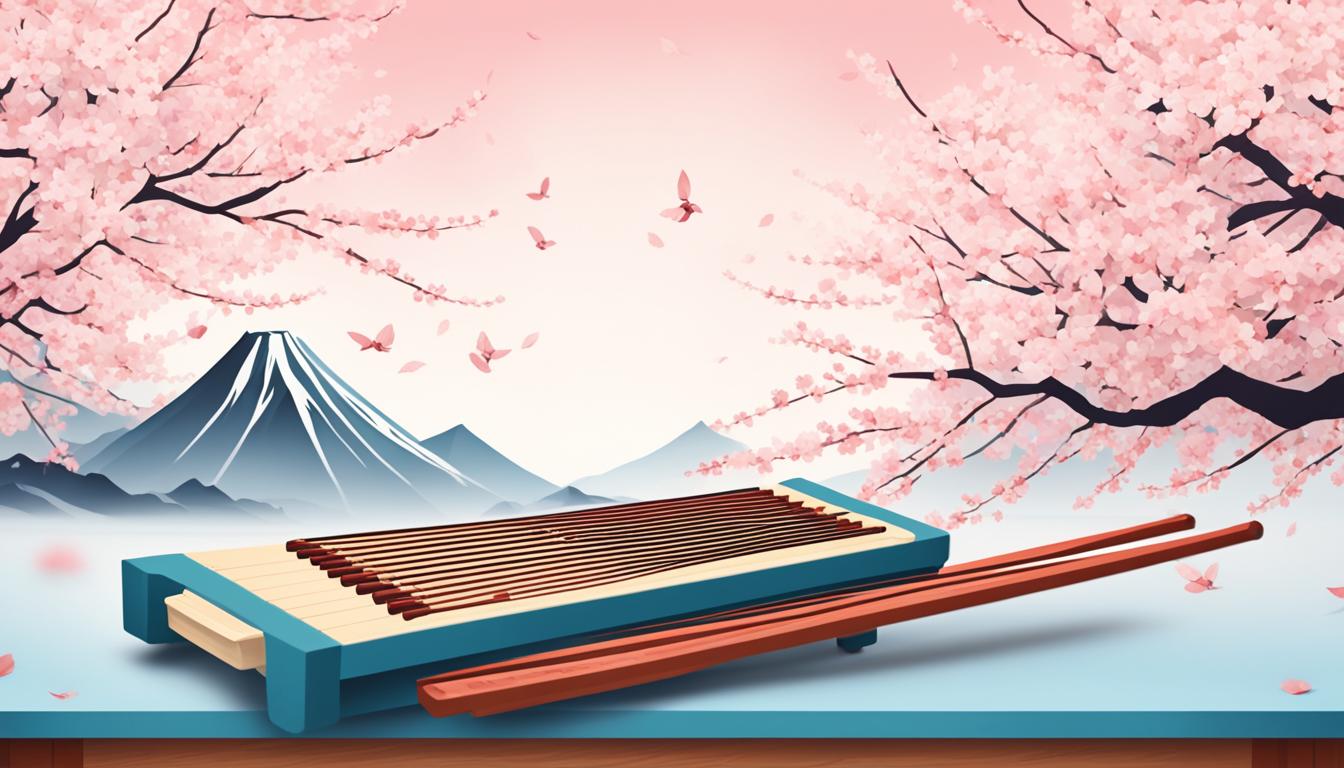
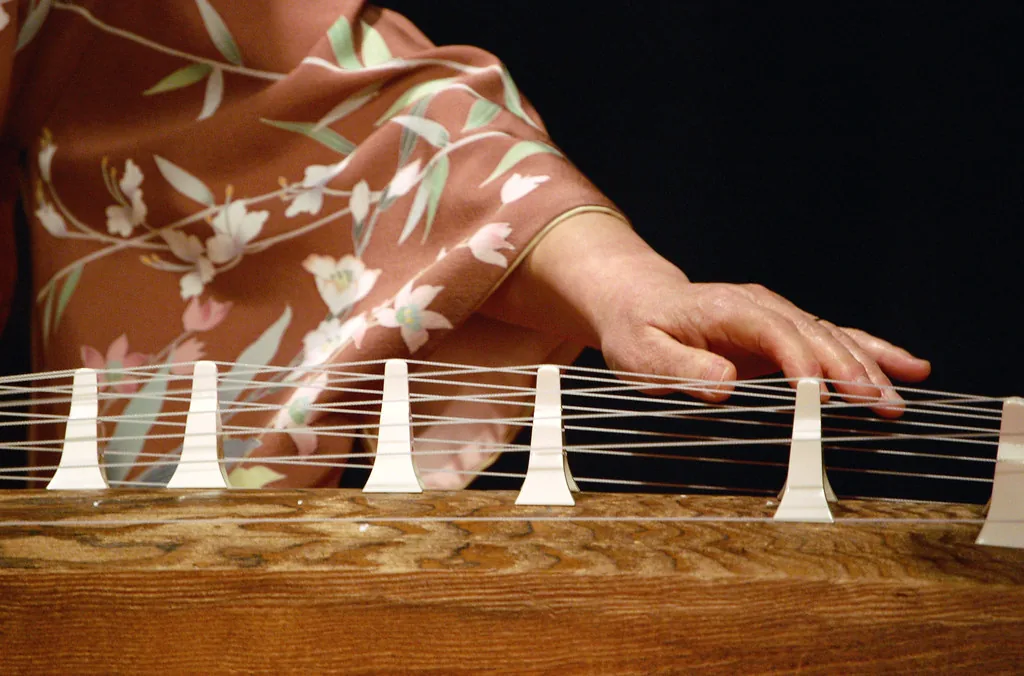
In Japan’s rich musical tradition, one of the most iconic string instruments is the Japanese koto. Originating in China, the koto is a long plucked zither measuring nearly 2 meters. Played horizontally, this Japanese musical instrument has 13 silk strings that are plucked with picks.
The koto plays an essential role in traditional Japanese music. It accompanies theatrical works such as kabuki and is used to create lyrical melodies. Its history dates back to Japan’s Nara period, and making one requires great craftsmanship. The koto’s unique sounds create a distinctive atmosphere in Japanese music.
Iconic Japanese Musical Instruments
Besides the koto, other iconic musical instruments have shaped the musical history of the Japanese archipelago. Among them is the shamisen, a plucked string instrument that provides the rhythm for traditional theater such as kabuki and is also played by geisha. The biwa is a short-necked lute once used to accompany tales of war. The taiko is a powerful Japanese drum used in battles and traditional festivals. The shakuhachi, a bamboo flute, was originally used in court music; today it is played solo or alongside other instruments. Finally, the koto, also called the “Japanese harp,” is a long plucked zither that accompanies traditional theater such as kabuki.
These iconic instruments reflect the richness of Japanese musical culture. Each has unique characteristics and contributes to the distinctive atmosphere of traditional Japanese music.
The History of the Shamisen
The shamisen is one of Japan’s best-known musical instruments. It is derived from the sanxian, a Chinese instrument, and was introduced to Japan in the 16th century. Originally, the shamisen was used in Japanese court music. It later became the instrument of choice for geisha, who often played it while singing.
The shamisen is a plucked string instrument measuring between 1 and 1.5 meters. Its resonating body is traditionally made of sandalwood and covered with cat, dog or snake skin. It has three strings and is played with a plectrum called a bachi. Playing it requires both skill and expressiveness.
Over time, the shamisen has become a versatile instrument used in styles ranging from traditional music to jazz, pop and even rock. It is valued for its distinctive sound and its ability to convey a wide range of emotions, from melancholy to exhilaration.
The shamisen is much more than a musical instrument. A voice for Japanese culture, it enables artistic expression that has endured through the ages while retaining its beauty and deep significance.
Japanese Court Music
The shamisen flourished particularly in Japanese court music, which was once reserved for society’s elite. This music reflected the social hierarchy and was performed at important ceremonies and celebrations. Court musicians, known as gakuso, mastered the art of the shamisen and were highly respected for their musical skills.
Court music was often accompanied by singing and dancing, creating a majestic and refined atmosphere. The shamisen was one of the central instruments in these performances, contributing harmony and rhythm.
The Role of Geisha
Geisha, Japan’s traditional artists and entertainers, also adopted the shamisen as their instrument of choice. They were skilled musicians as well as talented singers and dancers. Their shamisen performances were graceful and captivated audiences with their virtuosity and charm.
Today, the shamisen remains a symbol of Japanese culture. It is appreciated for its musical beauty and its role in preserving traditions. In theatrical productions, festivals and modern recordings, it continues to resonate with listeners and bring the sounds of Japanese history to life.
The Shamisen in Popular Culture
The shamisen has an important place in Japanese popular culture. This plucked string instrument often appears in Japanese films, manga and anime, where it creates a traditional and mysterious atmosphere. Its characteristic tone and association with Japanese culture deepen the atmosphere of these works.
In the film Zatoïchi, directed by Takeshi Kitano, the main character is a blind wanderer who plays the shamisen. The instrument’s captivating sound accompanies his actions and adds another dimension to the story. The shamisen also appears in other well-known Japanese manga and anime, such as Gintama, Demon Slayer and Naruto. These works use the shamisen to immerse audiences in a traditional world and strengthen the authenticity of their stories.
In Japanese films, manga and anime, the shamisen creates a traditional and mysterious atmosphere that strengthens the authenticity of the stories.
| Japanese films | Manga | Anime |
|---|---|---|
| Zatoïchi | Gintama | Demon Slayer |
| Naruto |
The Shamisen in Zatoïchi
The film Zatoïchi, directed by Takeshi Kitano, features a blind wanderer who plays the shamisen. The instrument’s hypnotic sound accompanies the adventures of this iconic character and adds another dimension to the story. The shamisen plays an essential role in the storytelling of this celebrated Japanese film.
The Shamisen in Manga and Anime
The shamisen is also used in many Japanese manga and anime to create a traditional atmosphere. For example, in the manga Gintama, one of the main characters, Tsukuyo, is a geisha who plays the shamisen. The instrument lends authenticity to the character and the story. Likewise, in the anime Demon Slayer and Naruto, the shamisen appears in the soundtrack to reinforce the atmosphere and cultural identity of the stories.
Conclusion
Japanese string instruments such as the koto and shamisen hold an important place in traditional Japanese music and are symbols of Japanese musical culture. Their history stretches back centuries, and they remain part of Japanese music and culture. Their unique sounds create a distinctive atmosphere. Learning about these instruments and their history gives us a better understanding of the richness and diversity of traditional Japanese music. In religious rituals, theatrical works and contemporary performances, Japanese string instruments continue to enchant listeners and pass on the musical traditions of this fascinating country.
Traditional Japanese music is deeply rooted in the country’s culture, and Japanese string instruments are an essential part of it. They are used to express emotions, accompany rituals and ceremonies, and tell stories through music. These instruments have evolved over time, but they retain their essence and importance in Japanese musical culture.
Japanese musical culture is closely tied to the country’s history and traditions. Japanese string instruments help preserve and pass on these traditions from one generation to the next. Music plays an important role in the daily lives of Japanese people, whether they are celebrating special moments, taking part in festivals or simply enjoying the beauty and emotion of traditional Japanese music.
FAQ
What is the Japanese koto?
The Japanese koto is a plucked string instrument that is emblematic of Japanese culture. Originating in China, it is a long horizontal zither measuring about 2 meters and fitted with 13 silk strings. It is used in traditional Japanese music to accompany theatrical works and create lyrical melodies.
What is the history of the Japanese koto?
The history of the Japanese koto dates back to Japan’s Nara period. It was influenced by the Chinese zither, and making one requires great craftsmanship. Over the centuries, the koto has become an essential instrument in Japanese music while preserving its tradition and unique sounds.
How is the koto played?
The koto is played horizontally: its silk strings are plucked with picks. Musicians use particular techniques to produce different sounds and embellish melodies.
What other Japanese musical instruments are iconic?
Besides the koto, iconic Japanese musical instruments include the shamisen, the biwa, the taiko and the shakuhachi. Each has its own history and uses in Japanese music and culture.
What is the shamisen?
The shamisen is a plucked string instrument of Chinese origin that was introduced to Japan in the 16th century. It measures between 1 and 1.5 meters long and is often used in traditional theater and played by geisha. Its resonating body is traditionally made of sandalwood and covered with animal skin.
How is the shamisen used in Japanese popular culture?
The shamisen has an important place in Japanese popular culture. It often appears in films, manga and anime, where it creates a traditional and mysterious atmosphere. Famous characters such as Zatoïchi have contributed to its popularity.
What can we conclude about Japanese string instruments?
Japanese string instruments such as the koto and shamisen are symbols of Japanese musical culture. Their history stretches back centuries, and they are still used today to pass on Japan’s musical traditions. Their unique sounds and presence in popular culture continue to inspire interest in these traditional instruments.