
Objective: to provide a comprehensive guide offering a clear overview of the instruments often grouped under this name in France.
This short guide introduces their definitions (târ, setâr), musical context (dastgâh, radif), long history up to the present day, and connections with poetry, visual arts and instrument making.
Iran is a culturally diverse region. The same instrument varies between regions, including in the north, complicating the idea of a single standard model.
For a French audience, the article uses accessible language without requiring music theory, and offers concrete examples, listening suggestions and resources for further exploration. Note: the term does not refer to just one instrument. The article explains the instrument families and how the term is used.
Learn more about the music and the
Why Persian lutes still fascinate audiences in France today
In France, interest in these instruments comes from the meeting of timbre, history and imagination.
The dastgâh modal system offers microintervals and opportunities for improvisation that appeal to musicians and music lovers. Its sound has an expressive range quite different from that of Western music.
The poetic dimension adds to this appeal: the writings of Hafez and Rumi shape how the music is received in France. Listening becomes a literary as well as a musical experience.
- Art of timbre and virtuosity: the subtlety of the playing attracts conservatories and world music venues.
- Society and history: transmission, institutions and places of performance provide the cultural depth that audiences seek.
- Usage in France: the term may refer to several instruments (târ, setâr); a precise overview helps prevent confusion.
In practice, these strings can be heard in concerts, instructional videos and recordings. Audiences often want to identify an instrument, grasp the modes and understand music’s social role.
For further reading, a useful resource on context and transmission can be found here: research and musical context.
Next: having explored this cultural appeal, we turn to the instruments’ characteristics and main families.
Defining Persian lutes and their main families in Iran
Let us begin with physical features—the neck, body and strings—to build a coherent group of instruments. A lute can be described simply: a resonating body, a neck with frets or markers, and plucked strings that produce sound.
Organological features: neck length, body size and shape, and string type affect timbre and use. A long neck allows a wider range and supports ensemble playing. A large body produces greater projection.
Long-necked lutes: this group includes instruments that often lead an ensemble section. Their volume and range make them central to classical music. The târ has a central place here: used both solo and in ensembles, it shapes the repertoire and serves as a teaching instrument.
Setâr: more intimate, it offers a range of subtle nuances. Its voice suits solo playing and meditative repertoire. Advanced amateurs choose it for its expressive sensitivity.
Other regional models, with varying names and forms, also enrich the picture without reducing the tradition to two instruments. The next section explains where these strings fit alongside the santur, ney and percussion that make up Iran’s soundscape.
Persian lutes: a survey of Iranian and Persian lutes
To see the whole more clearly, here is a simple mental map that places each instrument according to its role.
A mental map of the instruments
Position: plucked strings carry the melodic line and ornamentation; the santur adds brightness; the ney contributes its breathy color; percussion (daf, tombak) provides the rhythmic foundation.
This group sounds like a small orchestra in which each timbre complements the others. Their interaction determines the final sound in concert or on a recording.
What makes a survey different from a simple introduction
A survey connects the instruments’ features, performance practices, repertoires and historical contexts. It offers concrete points of comparison: timbre, sustain, projection, place in solo or ensemble playing, and accessibility for learners.
- Melodic role or role in the overall texture.
- Presence in the studio or on stage.
- Changes across periods (courts, institutions, media).
| Instrument | Timbre | Main role | Common use |
|---|---|---|---|
| Setâr / târ | Warm, ornamented | Melody, ornamentation | Solo, classical ensemble |
| Santur | Bright, percussive | Texture, brilliance | Accompaniment, instrumental pieces |
| Ney | Airy, expressive | Color, long melodic lines | Song, improvisation |
| Percussion | Rhythmic | Foundation, dynamics | Ensembles, accompaniment |
From ancient empires to the pre-Islamic era: cultural roots
Before the Islamic era, powerful empires shaped the region’s political and artistic settings. These centuries provide useful reference points for understanding the continuity of musical practices and courtly narratives.
Arsacid and Sasanian dynasties: language and power
The Arsacid dynasty (around 247 BCE–224 CE) spoke Parthian. The Sasanians (224–651) used Middle Persian. These language differences matter: they determine which sources survived and how inscriptions are read.
The transmission and translation of knowledge
Centers of learning translated Greek texts into Middle Persian and then into Arabic. This exchange made the region a place of transmission where science and the arts circulated.
At Naqš-e Rostam, inscriptions (Shâpour II, Kirdir) remain key witnesses to political and religious history. Despite the loss of many documents, modern studies are gradually reconstructing the picture.
The role of the king and the empire shaped court culture. Patrons determined which instruments and narratives were valued, laying the groundwork for the Islamic era that followed.
From Islam to the Iranian dynasties: changes in musical practice
Religious and institutional changes reshaped the places where music was performed and passed on.
Islam, power and culture: continuity and change
Islam did not erase earlier traditions. It did, however, change their status, settings and norms. Courts, tribunals and religious spaces redefined instrumental practices.
Twelver Shiism and institutions (waqf)
Twelver Shiism established legal frameworks that influenced patronage and teaching. The waqf became a central means of funding schools, mosques and workshops.
These endowments shaped society and the architecture of places of learning. A study of Safavid waqfs shows how these funds organized cultural opportunities in society over the course of its history.
Sufism, mysticism and music
Sufism retains an important place in spiritual music. The breath of the ney symbolizes inner experience and gives rhythm to long periods of listening.
A productive tension emerges: doctrine, power and the arts negotiate what is encouraged, tolerated or moved elsewhere. These dynamics set the stage for the Safavid and Qajar periods, then for modern disruptions.
Safavids, Qajars and the contemporary era: a timeline of major changes
Studying changes century by century helps explain why some instruments became more prominent. The Safavid period (16th–18th centuries) brought substantial organization of power and patronage. Waqfs funded schools and workshops; the court shaped the musical scene. This framework linked religion, society and artistic practice.
Safavids: institutions and patronage
The Safavid dynasty strengthened religious and cultural institutions. Shiism became a means of establishing social order. Religious endowments supported training and the spread of repertoires.
Qajars: prominence and change
The Qajar era saw urban music scenes take new forms. Salons and courts helped artists circulate. Some instrumental voices became more emblematic. The dynasty shaped the public image of musical practice.
20th–21st centuries: media, regulations and innovation
In the 20th century, radio and then television (in the 1950s and 1960s) greatly expanded the audience. After 1979, regulatory constraints transformed creative work. Even so, classical, popular and diaspora scenes continued to innovate and reach international audiences.
- Timeline: Safavids = institutional development; Qajars = greater prominence; 20th century = mass circulation.
- Dynastic framework: the court organized the movement of artists and shaped the image of instruments.
- Modernization: radio, television, recordings and videos changed listening and performance.
For more on cultural context and transmission, see this resource on Iranian music. Understanding these changes helps explain its musical grammar: the modal system (dastgâh) sheds light on what is played across different periods.
The modal system (dastgâh): the musical grammar of Iranian music
Understanding the Iranian modal system helps explain why melodies seem to move and unfold instead of progressing through fixed chords.
Understanding it without Western music theory: mode, color and direction
Dastgâh refers to a modal framework. It combines a scale, characteristic motifs, points of emphasis and an expressive path through time.
Rather than a contrast between major and minor, listeners perceive colors and tensions that evolve during a performance.
Microintervals and quarter tones: how they change listening
Microintervals, especially quarter tones, create a sense of movement and ornamentation. They make the listening experience more nuanced.
These inflections require a trained ear and help explain the central role of musical memory.
Commonly cited examples and improvisation
Some frequently heard dastgâhs are Shur (warm), Segah (melancholic), Chahargah (vigorous) and Homayoun (solemn, noble).
On a string instrument, these modes emerge through motifs and ornaments. Improvisation remains a form of freedom within a framework, grounded in memorized reference material (radif).
| Dastgâh | Character | Recognizable features |
|---|---|---|
| Shur | Warm | Songlike motifs, flexible points of emphasis |
| Segah | Melancholic | Prominent quarter tones, tension |
| Chahargah | Vigorous | High notes, rapid ornaments |
| Homayoun | Solemn, noble | Long lines, deep inflections |
Note: the music has developed in a culture shaped by Islam, although that does not entirely define its aesthetic logic.
The radif: repertoire, memory and a way of learning
The radif is a body of musical phrases preserved in the memories of masters. It provides a foundation for learning the modes, ornaments and ways of shaping a melodic line.
The radif as a structured body of music
Definition: the radif is a collection of gousheh—short melodic units—organized by mode. These units offer motifs to memorize and develop in performance and improvisation.
Learning and transmission
Teaching rests on the relationship between master and student. Oral transmission involves repetition, attentive listening and immediate correction.
Neither mechanical copying nor unrestricted invention: the student respects the style while finding a personal voice. Mirza Abdollah’s radif remains a frequently cited reference in this learning process.
The repertoire preserves a living memory: it connects present-day practice with cultural history through the continuity of schools and performers.
| Function | Method | Effect on the student |
|---|---|---|
| Melodic foundation | Memorizing gousheh | A trained ear, well-formed phrases |
| Framework for improvisation | Guided variations | Creativity within a framework |
| Transmission | Oral teaching, the master–student relationship | Continuity of style |
Persian poetry and song: when the lute accompanies words
Voice and poetry often form the heart of recitals, where instrumental accompaniment becomes part of the story. The instrument’s primary role is to support the vocal phrase, answer it and share its breathing.
Hafez and Rumi remain major touchstones: their themes—love, searching and mysticism—span the centuries and nourish contemporary musical literature. The verses guide prosody and the choice of emphasis.
On stage, the târ or setâr accompanies the vocal line, responding with short motifs. The accompaniment may highlight a pause, fill the space between two half-lines of verse or fall silent to leave the voice alone.
Ornamentation and expression
Tahrir is a vocal ornamentation technique: small tremors, curves and glissandos that add emotion and nuance. Instrumental ornaments sometimes mirror these gestures.
- Listening cues: the voice circles around a note; the instrument responds or falls silent.
- As the intensity rises, the accompaniment grows denser to build the narrative.
The dialogue between words and music turns each performance into a living reading.
Art, literature and royalty: Persian lutes in visual representations
The story of the Shâhnâmeh still shapes the visual and musical imagination of the court today. Composed by Ferdowsi in the early 11th century, this “Book of Kings” gave rise to a vast body of manuscripts copied and illuminated over the centuries.
Miniatures depict heroes, royal gestures and banquet scenes. In the Timurid and Turkmen periods (flourishing in the 15th century), these images formed iconographic programs designed to glorify power.
The Shâhnâmeh as a cultural foundation
Why this text still resonates: it underpins a collective memory of greatness and heroism. Safavid copies from the 16th century show the continuity of this visual model.
Illuminations and power
Anna Caiozzo has shown how Turco-Mongol rulers organized imagery to reinforce royal charisma. Court scenes combine political gestures, ceremonies and depictions of music.
King, empire and material culture
Representation legitimizes the king and the empire through art. Musical motifs also appear on ceramics and in palace architecture, signs of a dialogue between image and space.
Finally, the iconography points to physical objects: instrument construction and the choice of wood or skin give these images material form. The passage from miniature to material connects representation and sound.
“Court images turn learned culture into an instrument of power.”
Workshops, instrument making and materials: how a Persian lute is made
In the workshop, each step turns a piece of wood into a voice.
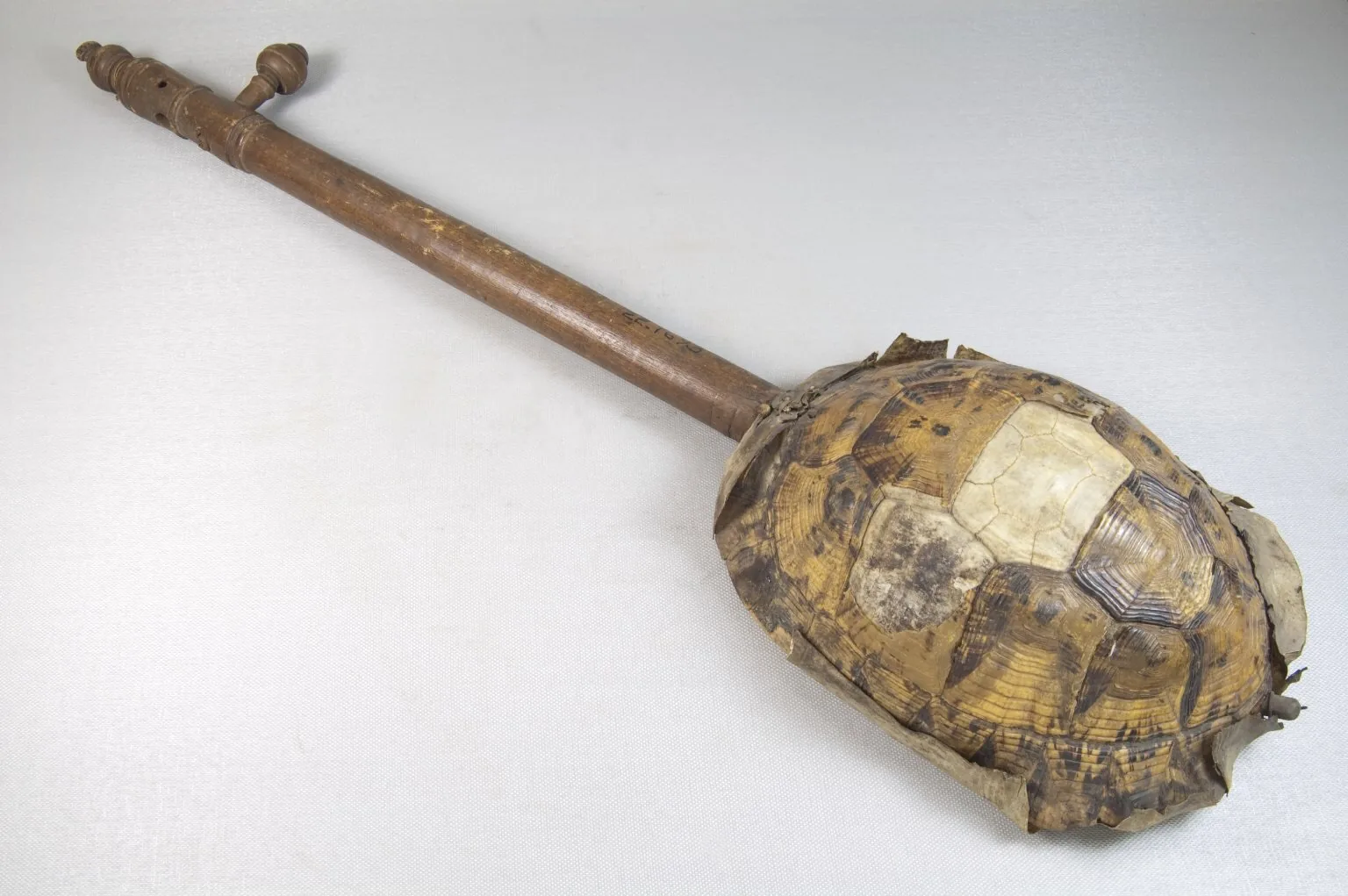
Steps: the maker chooses the wood (walnut, maple or birch), carves the body, assembles the neck, then fits the fingerboard and tuning pegs. Finishing affects projection and tuning stability.
Wood, skin and bridge
On some models, a skin membrane forms part of the soundboard. The bridge transmits vibrations; its height changes the tension and tonal color.
Tunings, strings and adjustments
String height, tension and bridge position alter the dynamic response. Wood thickness and varnish also affect the attack and sustain.
Assessing an instrument: check the neatness of its joints, the evenness of the fingerboard and how comfortable it is to play. Ask the maker where the wood came from and which adjustments are recommended.
Practical advice: before buying, test the instrument after it has been tuned for a few hours. For maintenance, change the strings regularly and keep the instrument dry.
In local material arts such as ceramics, skillful finishing helps define the aesthetic. Here, it can be heard as well as seen.
For advice on assessing an artisan-made instrument, see how to recognize a violin made by a luthier.
The santur alongside the lute: complementary roles in a Persian ensemble
The hammered zither has an important place alongside string instruments. Its sharp attack creates a shimmer that contrasts with a gentler articulation.
Why these timbres respond to each other
Contrast: striking the santur produces rapid overtones. The other instrument favors ornamentation and sustained notes.
Together, they cover complementary ranges. The first adds clarity; the second provides melodic continuity.
A typical ensemble and its balance
In a common arrangement, the lead voice carries the melody. The santur sometimes doubles the line or adds bright accents. The strings provide countermelodies and ornaments.
In concert or in the studio, performers balance the sound through changes in dynamics and by leaving room for silence.
Radif, compositions and schools
The radif remains the foundation held in memory. Recent compositions borrow its melodic units or invent new developments. Schools pass on a continuing tradition, while each generation contributes measured arrangements.
Listening cues: identify the hammer strikes, then listen for ornamented responses. The ensemble changes from region to region, revealing the tradition’s diversity.
| Element | Role | Characteristic |
|---|---|---|
| Santur | Color, brilliance | Percussive attack, shimmer |
| Necked instrument | Melody, ornamentation | Plucked articulation, sustain |
| Ensemble | Sonic balance | Alternation between density and space |
Listening to these exchanges reveals how memory and creativity coexist in every performance.
Regions, northern Iran and cultural diversity: beyond “Persian”
Iran’s regions offer a mosaic of sounds often missing from general descriptions.
Why discuss the regions: describing all the music with a single word obscures very different languages, styles and uses within one country.
Folk music and identities
Kurdish, Azeri, Balochi and other traditions form living repertoires. They can be heard at festivals, weddings and seasonal rituals.
Transmission often takes place within families. Rhythms, dances and some instruments vary by locality.
Travel, observation and sources
Field travel reveals practices that recordings cannot show: musicians’ status, occasions for playing and local improvisation.
Direct observation also helps identify practices accurately and avoid exoticizing them.
| Region | Sonic features | Contexts | Mode of transmission |
|---|---|---|---|
| North (Caspian region) | Fast motifs, light percussion | Rural celebrations, dances | Family, local workshops |
| Kurdistan | Powerful voices, wide-ranging modes | Epic songs, ceremonies | Oral transmission, master to student |
| Azerbaijan | Lively rhythms, mugham influence | Festivities, salons | Regional schools |
| Balochistan | Dry sounds, pronounced percussion | Weddings, tribal rituals | Transmission between generations |
A critical perspective: naming practices accurately, understanding music’s social role and connecting regional traditions with classical music help avoid generalizations.
Language, texts and Iranian studies: understanding instruments through sources
Epigraphic and literary archives offer ways to connect sounds with their contexts. Studying languages helps readers understand how terms and uses have changed over time.
Languages, writing and epigraphy: useful reference points
Linguistic reference points: Parthian, Middle Persian and Persian correspond to distinct historical periods. Knowing these names makes texts and scholarly editions easier to find.
Epigraphy plays a central role: Arsacid and Sasanian inscriptions, such as those at Naqš-e Rostam, offer clues to political and religious contexts.
Books and access to texts in French
For a starting point, choose annotated editions. The collective volume L’Iran des sciences humaines (edited by Homa Lessan Pezechki, 2025) brings together multidisciplinary articles useful for connecting history, literature and language.
A practical method: always distinguish primary sources, translations and commentary. Look for introductions in French, university catalogs or specialized libraries for better access to the texts.
Understanding literature and languages deepens knowledge of musical practices and the perception of timbre.
Listening to and recognizing a Persian lute: a guide for today
Learning to listen turns an audio track into a map of timbres and forms. This short practical guide offers clues for identifying a string instrument, understanding modern formats and following improvisation as a story.
Identifying a timbre in a recording
A quick method: first listen to the attack (sharp or soft), sustain (long or short) and brightness (whether overtones are present). Notice the harmonic density: a richer, louder sound often points to an instrument with a larger body.
Ornaments: close-knit runs and short glissandos suggest playing associated with the setâr; more powerful, structured motifs often suggest the târ.
Modern formats: studio, video and streaming
In the studio, mixing can emphasize brightness and compress dynamics. In videos, a performer’s movements can help confirm the instrument’s identity. On streaming platforms, playlists and algorithms make discovery easier but can sometimes obscure subtle sonic distinctions.
What improvisation tells us
Improvisation follows an implicit form: a slow introduction (establishing the mode), development (building intensity), then resolution. Listen for moments when the instrument “speaks” without a voice: they reveal the memory of the radif and the conventions of the dastgâh.
Advice for a listening journey: begin with slow pieces to hear the microintervals. Move on to virtuosic passages. Finally, compare several performers playing in the same mode to sharpen your ear.
Result: you will be able to name, place and listen to the instruments, then connect what you hear with a broader musical and visual history.
| Listening focus | Sonic clue | Interpretation | Useful application |
|---|---|---|---|
| Attack | Sharp or soft | A more percussive or more intimate instrument | Distinguishing the târ from the setâr |
| Sustain | Long or short | Large or small body | Choosing a reference recording |
| Ornaments | Runs, glissandos | The musician’s school or style | Comparing performers |
| Format | Studio, video or streaming | Effect on perception | Adapting your listening method |
Conclusion
In conclusion, this guide places a category often used in France within a broader landscape of instruments. Instruments such as the târ and setâr take on meaning as part of a larger sound world.
Remember three keys: a long history (the pre-Islamic era, dynasties and modernity), a musical grammar (dastgâh, microintervals) and a method of transmission (radif, the master–student relationship).
Poetry and images—Hafez, Rumi and the Shâhnâmeh—enrich listening and representation. Today, international performances, streaming and video offer many ways to explore them from France.
To practice, choose a track, try to identify the instrument, note the mode if you can, then read a short excerpt of poetry to connect words and sound.