
What this guide offers: it helps you understand the early lute, what sets it apart, and how its construction and playing technique shape its gentle, intimate tone.
We will follow a clear path: Middle Eastern origins, including the oud, then European developments. We will then explore technique — strings, tunings and frets — listening, and repertoire.
Its sound evokes courts, private rooms and festivals. This close, intimate tone is better suited to listening nearby than to large modern halls.
Scope: we consider the historical instrument and its development into the Renaissance, since the sources and playing practices often illuminate one another.
Finally, the sections cover history, lute making, strings, tablature, continuo, comparisons and advice for readers in France. The connecting thread runs from materials → gestures → sound → choice of pieces.
Understanding the medieval lute and its importance in early music
To understand this instrument is to grasp the relationship between the hand, the string and the sounding space. Here, plucking shapes everything: a clear attack followed by a decay that brings out the details.
A plucked string instrument with an intimate tone
As a plucked string instrument, it produces a precise attack. Its sound stays close to the listener, making the inner voice and subtle variations audible.
Between courtly practice, music at home and accompaniment
At court and in homes, it accompanies singing and supports the harmonic structure. Its role ranges from companion to poets to rhythmic support for musicians.
- Plucking encourages articulation and nuance.
- The intimate sound makes inner voices easy to hear.
- It belongs to a family of instruments that would develop into larger forms.
The origins of the medieval lute, from the Middle East to Europe
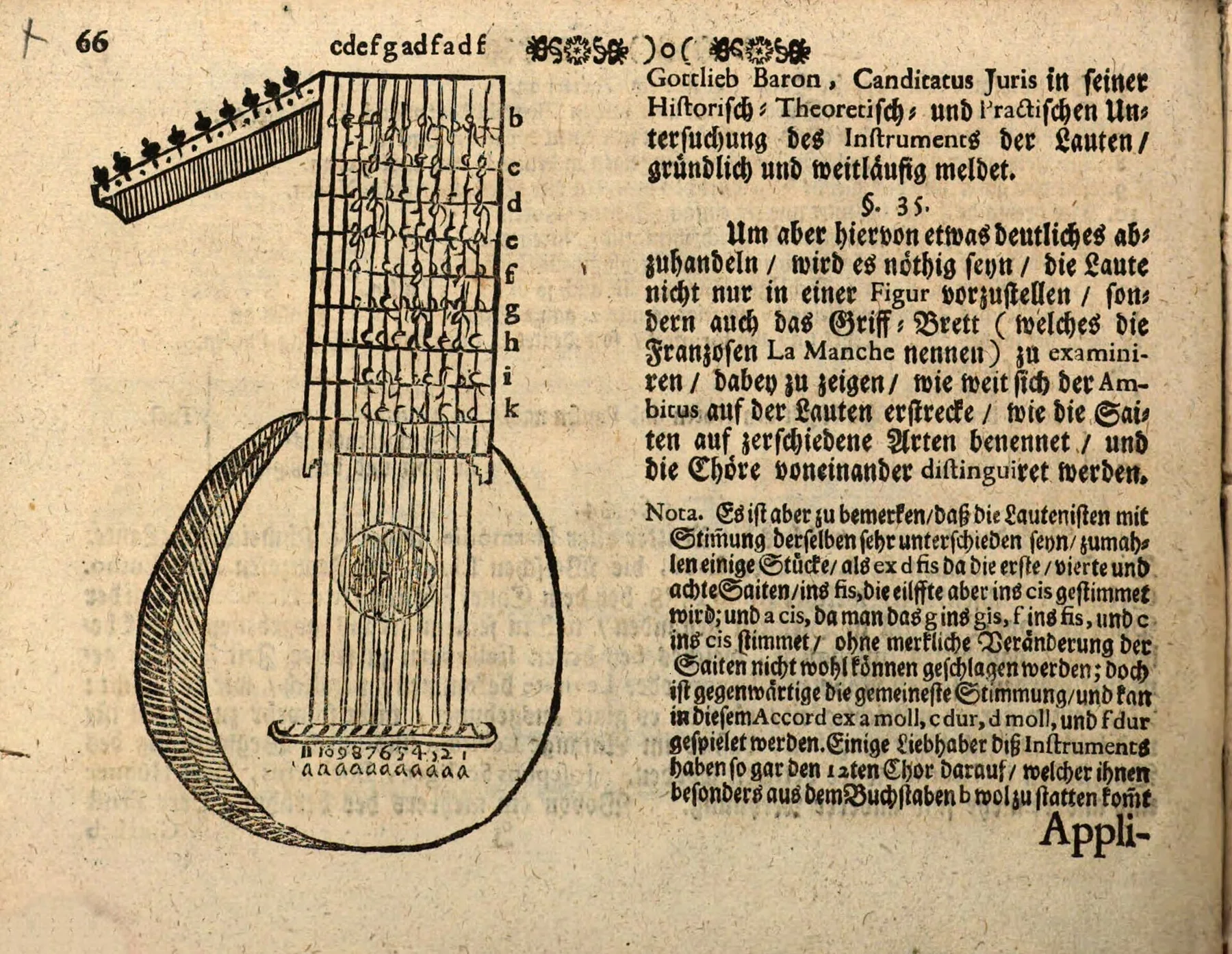
The roots of this pear-shaped instrument reach far to the south and east of the Mediterranean basin.
The legacy of the Arab ʿūd and Iranian barbat
The model descends directly from the fretless ʿūd and, more broadly, from the Iranian barbat. The pear shape remains constant while technical details evolve.
Spread through Spain and the Crusades
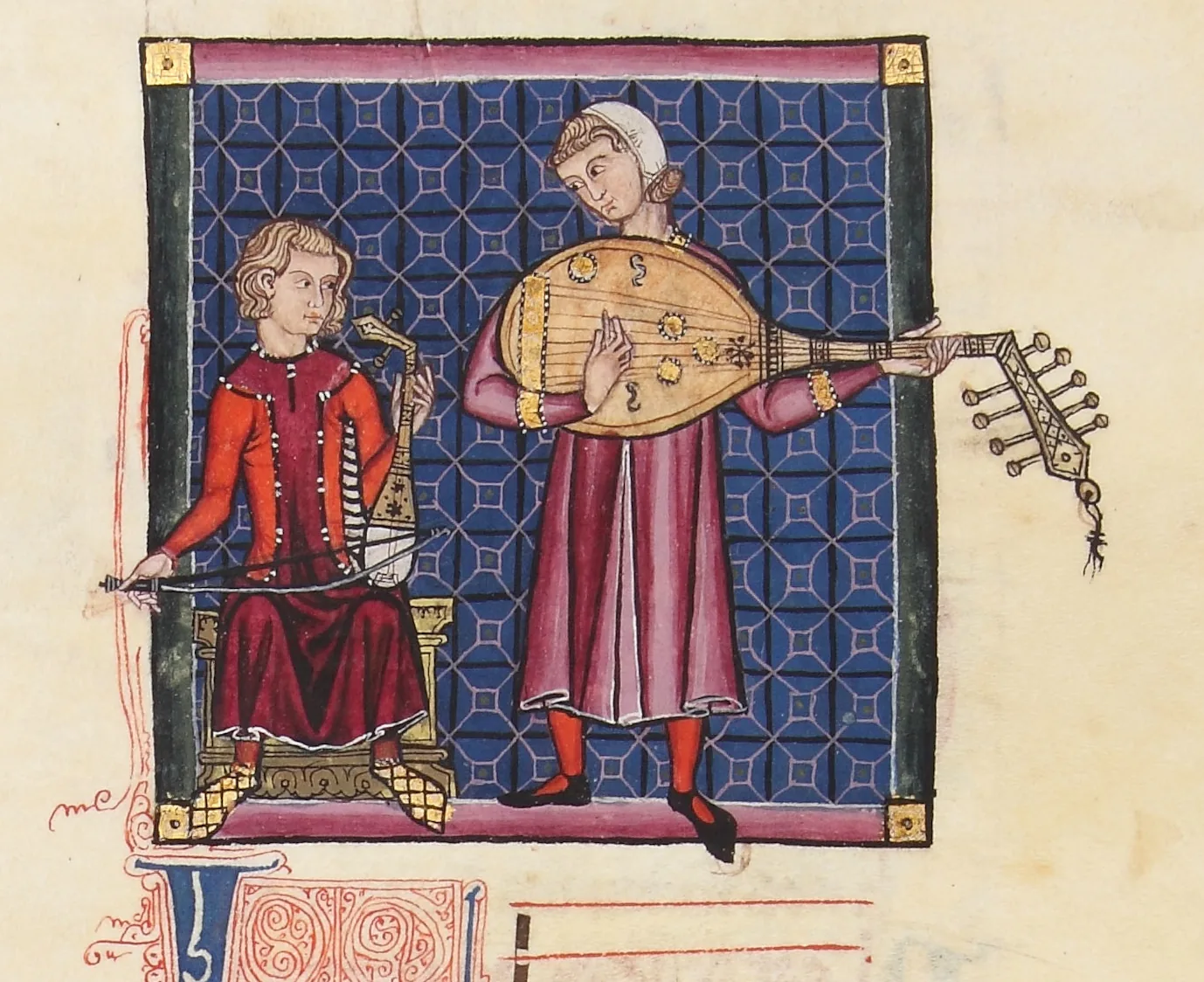
Contacts in Spain, especially under Moorish influence in the thirteenth century, helped bring the instrument into European use. The Crusades also carried players, makers and repertoires between worlds.
Early forms attested since antiquity
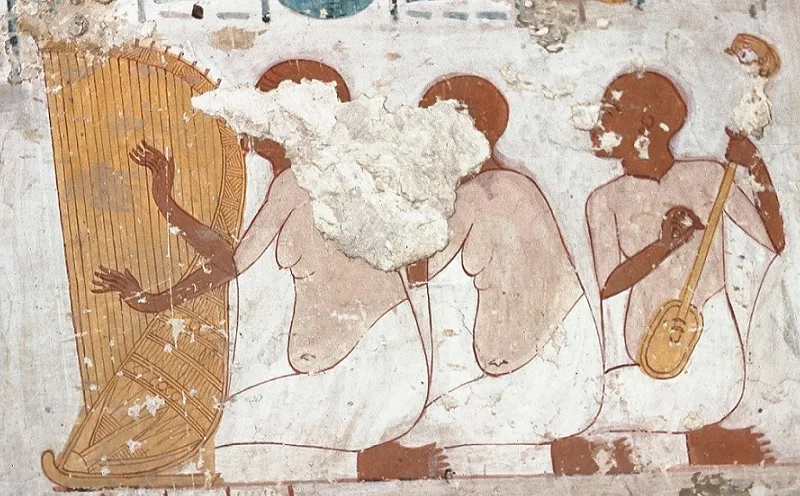
References to instruments with a body and neck can be found in Mesopotamia as early as around 3100 BCE. This shows that the underlying idea is thousands of years old.
“Instruments travel along human routes: craftspeople, musicians and techniques move together.”
- Instrument design: the pear-shaped outline endured while the frets and neck gradually changed.
- Geographical route: Middle East → North Africa → Spain → Europe.
- Key difference: the absence of frets on the ʿūd changes its ornamentation and melodic approach compared with other string instruments.
From medieval lute to Renaissance lute: continuities and changes
The Renaissance stabilized the instrument’s outline while opening up new musical possibilities.
Enduring features remain visible: the pear-shaped body and rounded back. The instrument is still held horizontally. It retains an accompanying role in vocal ensembles and music at home.
The changes lie in its construction. Makers refined the body’s curvature, made its outline more consistent and increased string tension. These choices met the demands of denser writing in the fifteenth and sixteenth centuries.
From plectrum to finger playing
Use of the plectrum gradually declined in favour of playing with the fingers. This improved articulation and control of dynamics.
It became possible to separate several lines, bring one voice forward among others and play more complex arpeggios. This technique encouraged polyphony and independence between voices.
| Feature | Continuity | Change |
|---|---|---|
| Outline | Pear shape, rounded back | Greater standardization and finer finishing |
| Playing technique | Horizontal position, accompaniment | Shift from plectrum to fingers, command of polyphony |
| Musical use | Accompaniment for singing and dance | Solo role and pieces composed for the instrument |
The Renaissance was therefore a period of transition: the instrument remained present in homes and at court, while also becoming a solo instrument for which music was composed. For more on the musical context of the period, see Renaissance music.
Lute characteristics: body, neck, pegbox and rose
To examine an instrument, first identify its body, neck, pegbox and rose. These parts work together: each affects the sound and the instrument’s mechanical stability.
Rounded, ribbed back made from thin strips of wood
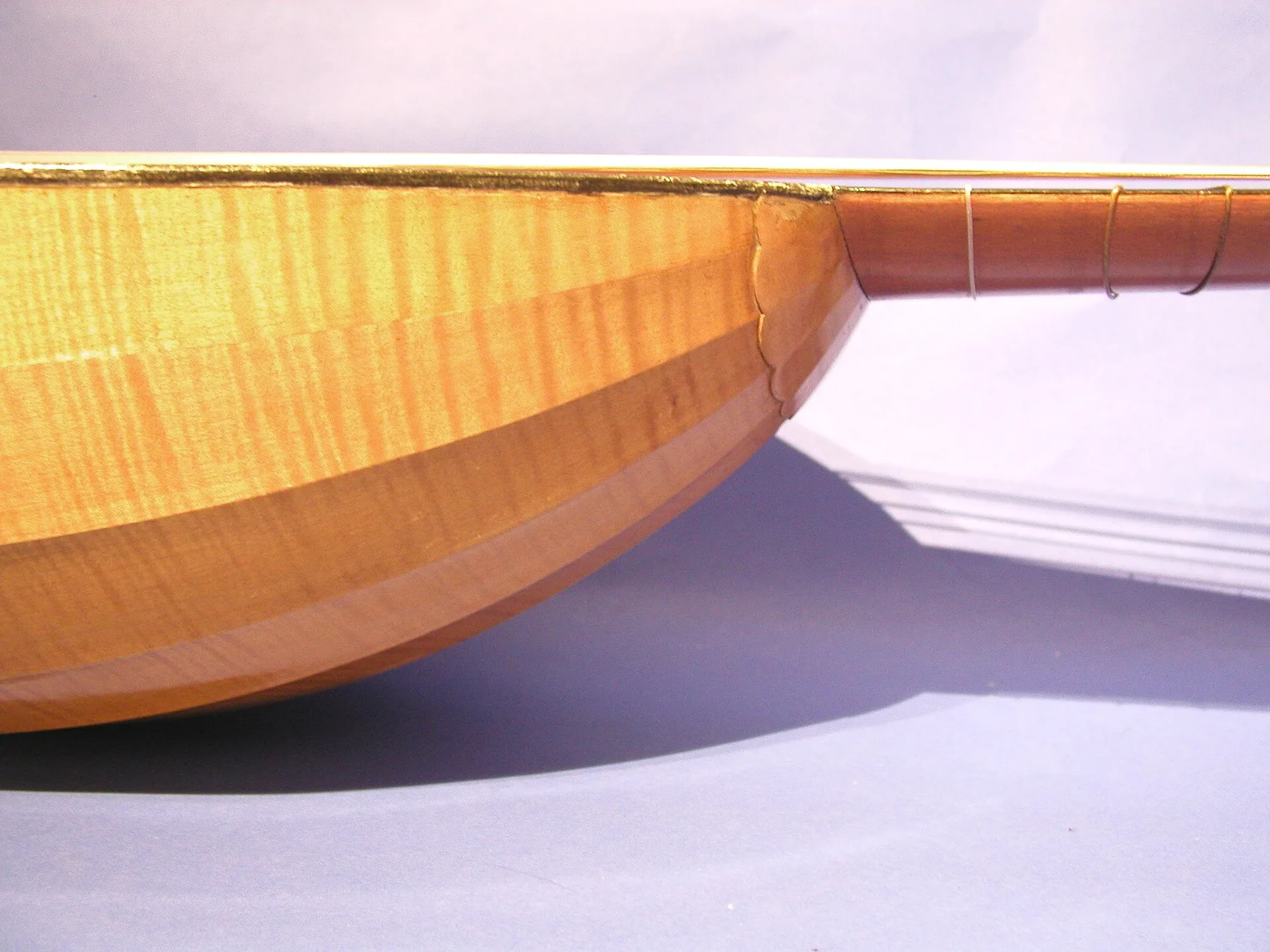
The back consists of thin strips glued together, often maple, yew or sycamore. This ribbed construction creates a deep curve that enriches the bass.
Flat soundboard and decorative rose
The top, usually made of spruce, is the main vibrating surface. The soundboard transmits energy from the strings, while the rose colours the sound and decorates the instrument.

Backward-angled pegbox and stable string tension
The angled pegbox increases the angle of the strings. This mechanical choice helps keep the tuning stable and contributes to the instrument’s distinctive outline.
Short, relatively wide neck
A short, wide neck makes chords and polyphony easier. It calls for a particular left-hand technique but offers some comfort for close fingerings.
In short: the body’s shape, choice of wood and assembly affect its moderate projection and intimate character. These choices explain why such instruments favour nuance over sheer volume.
“Careful construction turns raw material into a voice.”
| Part | Common materials | Acoustic role |
|---|---|---|
| Back | Maple / yew / sycamore | Curvature → fuller bass |
| Top | Spruce | Vibrating surface → clarity and responsiveness |
| Pegbox | Hardwood (acia) | String angle → stability |
| Neck | Hardwood, sometimes reinforced | Comfort for chords and polyphony |
Wood, craftsmanship and lute making: how a lute is built
Wood quality and the precision of the maker’s work largely determine the finished sound. The maker begins by selecting dry pieces of suitable density, taking care with the direction of the grain to maximize resonance.
Wood species and their acoustic roles: a spruce top encourages responsiveness and clarity. The back, made from thin strips of maple, yew or sycamore, colours the tone and stabilizes the structure.
The body is formed from curved strips that are then glued together. Every joint affects stiffness and the evenness of vibration. Precise gluing and careful shaping balance strength with freedom to vibrate.
What to look for: even ribs, clean joints, a thin soundboard and a well-aligned neck all indicate careful workmanship.
Construction lays the foundation; stringing and setup determine the final response. For pointers on a related instrument, see how to recognize a well-built instrument.
Strings, courses and frets: how the lute produces sound
The system of courses and frets defines both the range and the expressive possibilities.
Paired courses and the top string
A course is a pair of strings tuned together. These doubled strings give the attack more body and create a richer texture.
The top string, or chanterelle, is often single. It carries the melody more clearly when the other courses are doubled.
Gut strings: unison or octave
Gut strings offer a flexible response and moderate tension.
Unison tuning helps stabilize the treble; octave tuning is used mainly for bass courses. The octave gives the bass definition without making the sound too heavy.
Tied gut frets and intonation
The frets are made of tied gut and can be adjusted. This allows players to correct intonation for different temperaments and changes in humidity.
How many strings were there in different periods?
In the fifteenth and sixteenth centuries, six courses were common. Later, in the Baroque period, some lutes had as many as 13 or 14 courses.
Practical note: more strings extend the range, but do not always increase the volume.
| Feature | Function | Historical reference |
|---|---|---|
| Course | Doubled strings → richer harmony | Six courses (Renaissance) |
| Top string | Melodic voice, often single | Single on most lutes |
| Gut fret | Adjustable → precise intonation | Commonly used until the seventeenth century |
For details of its construction, see this technical guide.
Historical tunings and ranges: from “old tuning” to “new tuning”
Tuning structures the range and guides playing choices from one period to another.
Tuning in fourths and its relationship to the guitar
The sixteenth-century old tuning follows a pattern based on fourths.
In practical terms, this gives the fingering layout some similarity to that of a modern guitar.
Period tunings that favour certain keys
In the seventeenth century, the new tuning was adopted: some intervals changed.
The aim was practical: to obtain favourable resonances and make playing in D minor easier.
Effects on harmony, range and repertoire
The range depends on the number of courses and the chosen tuning.
A suitable tuning makes some chords more natural and others more difficult.
In practice, favouring D minor makes use of open strings and enriches the harmony.
The comparison with the guitar is useful for teaching: positions change, but the instruments do not always feel alike in the hands.
In practice, tuning and tension affect the right-hand attack, polyphonic clarity and stable intonation.
For points of comparison, see a discussion of the relationship between the mandolin and guitar.
Playing techniques: fingers, nails, plectrum and articulation
The gesture that makes the instrument sing begins in the right hand. It drives the sound: the angle of attack, depth of the pluck and alternation of the fingers shape the range of tone colours. A glancing touch gives a soft sound; a firmer attack produces a more incisive one.
The choice between the fingertip and nail affects brightness and precision. Historical schools vary: some musicians favour the warmth of the fingertip, others the clarity of the nail.
The left hand should aim for polyphonic clarity. Efficient positions, held notes and precise shifts keep the harmony from becoming blurred. Thoughtful fingering lets the voices breathe.
Ornamentation — trills, mordents and slides — forms an expressive language of its own. It shapes each phrase and highlights key moments in the melody.
The plectrum remains useful for some repertoires: it gives an even attack and a different phrasing. Finally, the instrument should be held in a relaxed posture, with a steady neck angle and still body, to ensure clear articulation.
The sound of the lute: projection, colour and intimacy
This instrument’s tone is most revealing in small spaces, where every detail can be heard. Its projection is modest; it does not fill a large hall like a violin or harpsichord, in keeping with its historical use in chamber settings and at court.
A delicate, nuanced sound suited to smaller spaces
Its colour is delicate: clear attacks, quick decay and fine nuances give the phrase room to breathe.
In practice, bass notes fade quickly, while the treble stays clear and precise.
Why it sounds more “direct” than a modern guitar
The body, string tension and design produce less overall volume. The contact between string and finger is immediately apparent, without a “veil” that obscures the details.
Balancing sharpness, warmth and audible detail
The result balances an incisive attack with the warmth of gut strings while keeping polyphony transparent.
Listening guide:
- Brief bass notes with a modest rhythmic presence.
- Clear treble notes and easily heard ornaments.
- A transparent polyphonic texture, ideal for intimate pieces.
Understanding this range of sounds helps with choosing repertoire and positioning the player in an ensemble. Construction and playing technique directly account for the results.
Medieval lute: characteristics, repertoire and sound
The instrument’s intimate voice comes from a precise combination of wood, strings and gesture. The rounded back, responsive top, doubled courses and gut frets provide a distinctive acoustic foundation.
The instrument is also shaped by an interaction: the choice of woods, stringing, tuning and way of plucking all influence the music played on it.
In practical terms, the move from plectrum to fingers broadened its solo possibilities. It became possible to separate voices, play diminutions and add fine ornaments that can be heard in a chamber setting.
Construction also affects the writing. Pieces that use open bass strings, ringing figures or light counterpoint make full use of the tone.
A quick way to read a score:
- Identify open notes: they are useful for resonance.
- Look for repeated figures: they may indicate ringing, campanella passages.
- Assess the density of the polyphony: the instrument favours clear textures.
This summary leads into the repertoire and composers, where the mechanics of the instrument become musical form.
Repertoire: musical forms and uses of the lute in the late Middle Ages and Renaissance
Music from the late Middle Ages and Renaissance offers a wide range of pieces for solo playing or accompaniment. Some forms served social occasions, while more learned works called for different technical and interpretive choices.
Dances and character pieces
Dances: a social function, strong rhythm and regular phrasing. They accompanied celebrations and dancing.
Character pieces: short, expressive works, often in variation form. They explore tone colour and ornamentation.
Fantasias and polyphonic writing
Fantasias work as laboratories for counterpoint. They draw on the clarity of individual voices and flexible fingering.
Accompanying the voice and working with other musicians
In accompaniment, the harmonic support remains discreet. It respects the singer’s diction and phrasing.
In ensembles, the instrument can support the bass, double a voice or play alone.
Transcriptions and how to choose
Transcription was widespread: vocal pieces and works for other instruments were adapted.
| Type | Use | Selection criteria |
|---|---|---|
| Dance | Social, rhythmic | Moderate speed, simple barre shapes |
| Character piece | Solo, expressive | Ornaments, control of sound |
| Fantasia | Polyphonic, learned | Density of voices, their independence |
| Transcription | Adaptation | Simplifying or enriching the lines |
Essential lute composers and figures
Among the names that mark the instrument’s history, a few provide useful starting points for listening and study.
John Dowland and the golden age
John Dowland remains an essential reference. His style combines measured melancholy, singing lines and restrained countermelodies.
We speak of a “golden age” when sources are plentiful: many pieces survive, the instrument enjoys high social standing, and teaching methods are well established.
To begin, try Dowland’s short airs, then his more developed pavans.
Towards the Baroque: Silvius Leopold Weiss
Silvius Leopold Weiss represents both continuity and Baroque development. His writing calls for a wider bass range, making instruments with additional courses useful.
The connection between composers and instrument making is clear: more courses support richer harmony and sustained bass lines.
- To begin: tackle accessible pieces first, then longer suites.
- For study: compare several performances to understand ornamentation and tempo.
- Context: read other articles on early music, such as those on this page, for points of comparison.
Notation and reading: understanding lute tablature
Lute tablature turns the musician’s movements directly into visual signs. It shows which string and fret to use: it describes an action rather than an isolated pitch.
Why tablature shows positions instead of notes
The principle is simple: tablature “depicts the movement” (string + fret). This matches how the instrument is played, especially with doubled courses.
In practice, a sign shows the string to pluck and the fret at which to place a finger. The player can immediately see where to put their fingers.
Effects on learning and interpretation
Advantages include a quick route to playing, a visual guide to chords and a natural way to grasp arpeggios. It is a practical shortcut when starting a piece.
Its limits are that players must develop their own harmonic understanding, mentally adjust for different tunings and check the intonation of gut frets.
- Learn by separating the voices and finding the top string.
- Work on the right hand so that your playing brings the notation to life.
- Check the tuning often: the frets can move.
- Prepare for continuo: tablature and staff notation coexist in accompaniment.
“Tablature teaches a sequence of actions: read, place, hear.”
To progress, combine reading the finger positions with harmonic study. A short article on playing technique often helps connect the page to the sound.
The lute in ensembles and basso continuo: from lute to theorbo
In the seventeenth century, the growth of vocal and instrumental groups changed how musical roles were shared. Denser ensembles needed distinct low notes for basso continuo.
The theorbo answered that need. It has two pegboxes and longer bass strings. Those strings are often played open and are not fretted, strengthening bass resonance. A so-called re-entrant tuning makes some note sequences possible without large hand movements.
The difference is quickly apparent in the sound. The long neck and strings produce a rounder, deeper tone. The lute retains a more incisive attack and finer detail.
The archlute sits between them: it offers the theorbo’s extended range while keeping a treble close to that of the lute. This balance makes it practical in chamber ensembles where ease of handling matters.
Composers and performers associated with continuo include Kapsberger, Piccinni, Robert de Visée, Castaldi and Hotman. The choice between theorbo, archlute and lute depends on the repertoire: opera, chamber music and solo accompaniment call for different instruments.
| Instrument | Characteristics | Ensemble role |
|---|---|---|
| Theorbo | Two pegboxes, long bass strings, re-entrant tuning | Basso continuo and bass support |
| Archlute | Extended range, manageable size, clear treble | A balance of solo and continuo playing in chamber music |
| Lute | Short neck, precise attack, strings under greater tension | Solo playing, intimate accompaniment, melodic detail |
Comparing the lute with related instruments: oud, guitar, mandolin and lyre
Comparing these instruments helps explain how their construction affects playing and repertoire.
Lute and oud: frets, tone and melodic approach
Frets or no frets: the fretless oud allows micro-intervals and expressive slides.
Frets give the lute fixed pitch positions. Slides are less free, but melodic lines are more sharply defined.
The tones differ: the oud often sounds warmer and more wistful, while the fretted instrument produces a brighter, clearer sound.
Lute and guitar: body, volume, tuning and modern use
The rounded back produces an intimate sound; the guitar has a flat back and projects more. A standard modern six-string guitar offers greater volume and range.
A guitarist cannot simply transfer their technique: doubled courses, string tension and articulation all call for adjustments.
Lute, mandolin and other plucked string instruments
The smaller, metal-strung mandolin has a more incisive attack and short resonance. It is often played with a plectrum.
The lyre, meanwhile, has an open frame and a sound closer to that of a harp. It shows how much an instrument’s structure changes its sound.
Choosing, caring for and hearing a lute in France today
Choosing an instrument rests on three criteria: type, comfort and musical fit.
Selecting an instrument for the period you want to play
First decide which period you want to explore. For the Renaissance, look for instruments with 6 to 12 courses and a moderate pitch standard. For late Baroque pieces, favour 14 courses or more.
Check that the neck feels comfortable, consider the vibrating string length and listen to the response in middle positions. An instrument suited to the music makes learning and interpretation easier.
Strings, setup and stability in everyday use
Gut strings: replace them regularly. They are sensitive to humidity and quickly lose tension.
Check the string height, fret positions and balance between bass and treble. Tuning a course in unison or at the octave changes its colour noticeably.
Stability depends on the wood, weather and tension. Establish a routine: tune before every rehearsal, check the fret knots and make small adjustments to tension after transport.
Where to hear the lute: concerts, ensembles and recordings
Seek out early-music concerts and specialist ensembles to compare tones and uses, including solo playing, continuo, archlute and theorbo.
For Baroque transcriptions and performance references, consult resources such as Baroque transcriptions.
To understand construction and the wider string-instrument family, this guide to string instruments in France is useful.
Practical advice: start with an instrument well suited to your repertoire. Mastering a simple model is better than struggling with a large, demanding one.
| Criterion | Indicator | Recommended action | Effect on sound |
|---|---|---|---|
| Number of courses | 6 to 12 (Renaissance) / 14 or more (Baroque) | Choose according to the repertoire | Range and harmonic density |
| Strings | Gut | Replace regularly and store in a dry place | Warmth and responsiveness |
| Setup | String height, fret position | Adjust yourself or ask a specialist maker | Intonation and playing comfort |
| Stability | Wood and humidity | Tune regularly; use a case and control humidity | Stable tuning and longevity |
Conclusion
The central point is simple: gesture, wood and tuning forge an intimate voice suited to chamber music and courtly playing.
Middle Eastern origins, European adaptation, rounded back, soundboard and rose, gut-string courses, historical tunings and refined technique all come together to produce a subtle tone.
The lute retains its place as both a solo and accompanying instrument. Playing it is also an art of listening, in which silence and nuance matter.
When choosing, always match the type, number of courses and tuning to the setting: solo playing, voice or ensemble. Explore the related instrument family to refine your choice.
Finally, from lute to theorbo and from the seventeenth century to today, keep listening actively: compare, practise polyphony slowly and let the instrument reveal its details.