
Brief introduction: this article compares two instruments from the same family. It explains what they have in common and what sets them apart. You will find visual and listening cues to help you recognize them.
Reading goal: to help you choose according to your project—solo playing, continuo or accompaniment. We will cover the historical context, then practical details: body, neck, pegbox, strings, tuning and notation.
In a Baroque orchestra, the theorbo remains subtle but indispensable because it shapes the harmony, as Thomas Dunford observes. The lute refers to a family of instruments; the term also covers variants such as the archlute and chitarrone.
Finally, we will suggest paths into the French music scene—Baroque orchestras, opera and chamber music—along with advice on learning and ergonomics.
Understanding plucked strings in early music
The appeal of plucked strings lies as much in the playing gesture as in the tone they bring to an orchestra.
Plucked string instruments are recognizable by their immediate attack, rich resonance and gradually fading sound. They provide harmonic and rhythmic support that helps higher-pitched instruments and voices stand out.
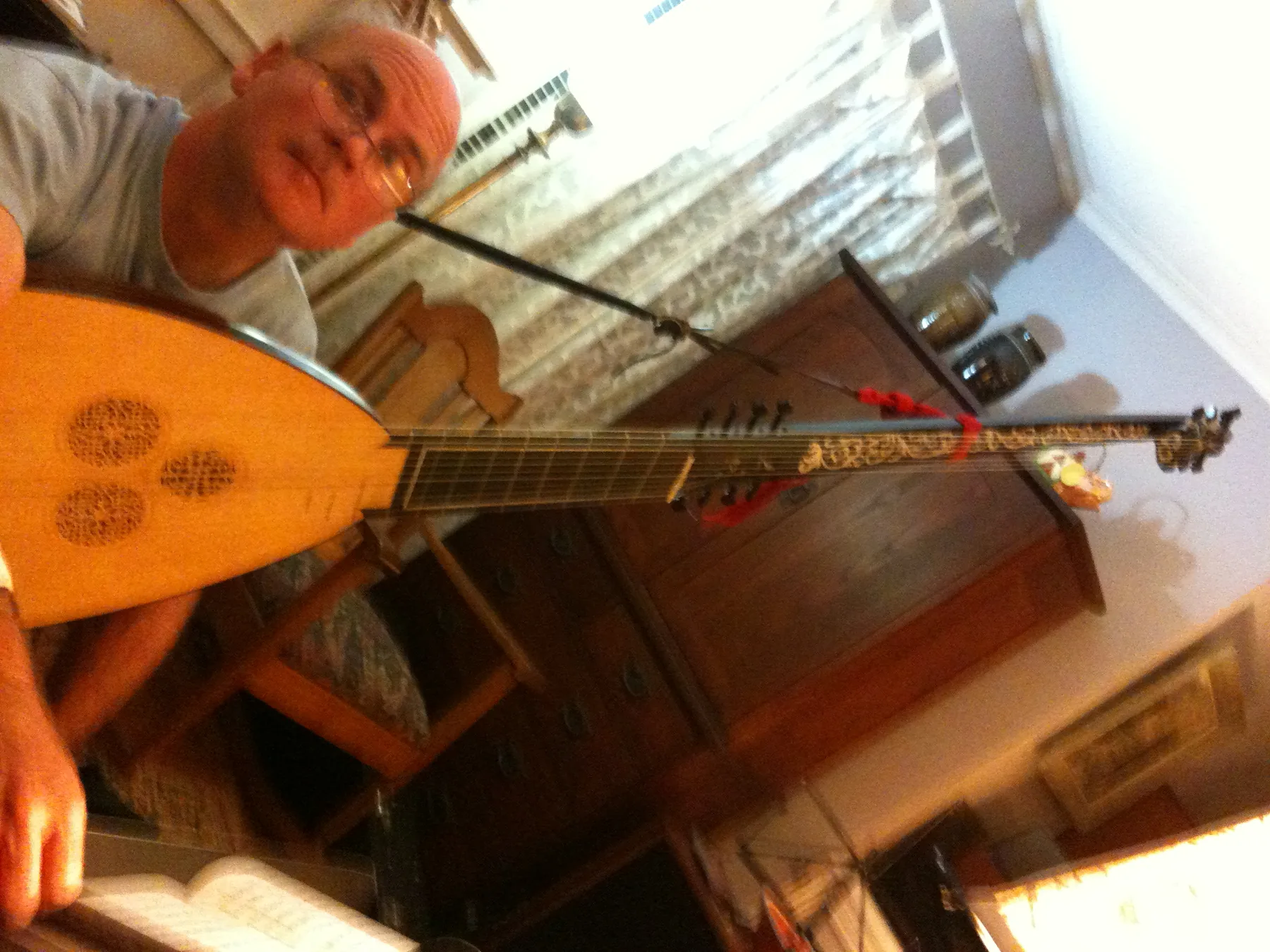
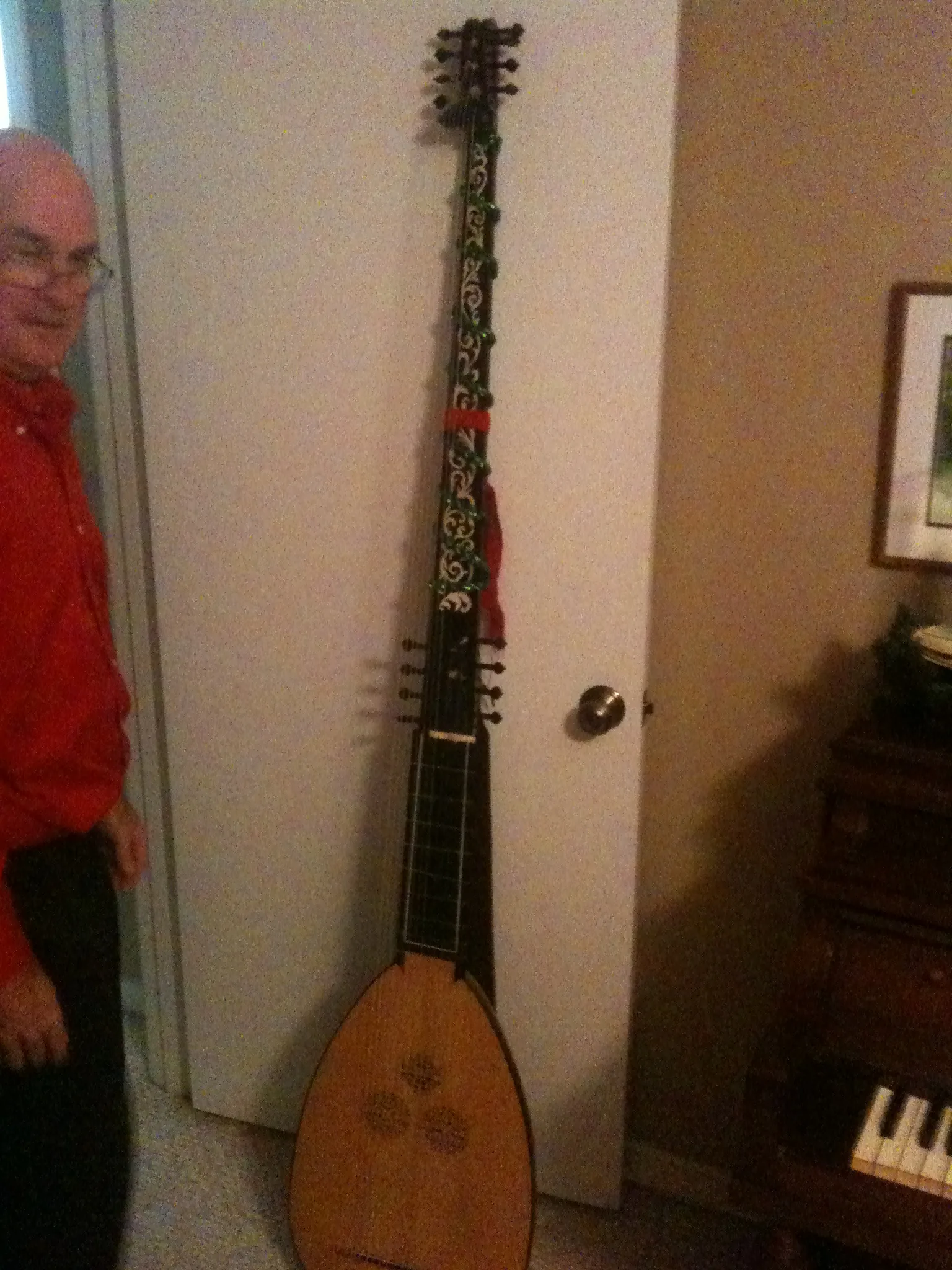
Visually, the very long neck and double pegbox surprise audiences. They give the instrument an unusual silhouette in the orchestra pit.
To the ear, its sound is often less direct than that of a harpsichord. Yet its support becomes palpable when the instrument disappears into the ensemble’s balance. Thomas Dunford sums up the idea:
“Subtle but indispensable.”
Let us clarify the names: lute refers to the family; lutes refers to its models across different periods. The archlute belongs to the Baroque tradition. In Italy, the name chitarrone is used.
A musician will often call themselves a lutenist even if they play the archlute or chitarrone. To learn more about the variants and their history, read this detailed article: lute history and types.
| Feature | Sound | Appearance |
|---|---|---|
| Attack | Direct, percussive | Visible neck and pegbox |
| Resonance | Long, gradually fading | Elongated silhouette |
| Role in the ensemble | Harmonic and rhythmic support | Subtle but present |
Why the neck looks so striking
The long neck produces deep bass notes through open low strings. This design choice explains its striking appearance and distinctive tone.
Origins and historical development of the lute in Europe
The European lute has roots in centuries-old Middle Eastern traditions.
Lute-like forms appeared in Mesopotamia around 3100 BC. Later, through trade and cultural exchange, the Arabic ʿūd, its ancestor, had a strong influence on Europe.
The main route ran through Spain. In the thirteenth century, the peninsula served as an entry point. Contact between civilizations helped the instrument spread.
From the Arabic ʿūd to the medieval and Renaissance lute
In the Middle Ages, its construction became more established. Its forms spread through courts and educated circles.
During the Renaissance, the instrument grew more complex: the number of courses increased, and finger playing sometimes replaced the plectrum. This change altered both composition and musical texture.
The Renaissance golden age and the transition to the Baroque
The Renaissance was the “golden age” of the Renaissance lute. European courts embraced it as a noble, respected instrument.
Over the following centuries, harmonic needs changed. Baroque music called for deeper bass notes and denser harmony.
Conclusion: technical and social changes led to new approaches to instrument making. Instruments with an extended range emerged to meet the demand for stronger bass notes.
The birth of the theorbo: meeting the need for deeper bass notes
In the early seventeenth century, music called for a more prominent bass to carry the harmony and support vocal delivery.
To meet this need, makers developed a later type of lute. This model extended the range downwards without changing the basic playing approach. It became known as the theorbo.
The double pegbox and long strings
A second pegbox makes room for long strings. These bass strings can be exceptionally long, increasing resonance and tension.
Fretted strings and extended basses: two complementary areas
The “small playing area” uses strings stopped against the fretted fingerboard. The left hand plays polyphony and the different voices.
The “large playing area” refers to the long open strings. They act like drones and create a harp-like tone.
- An extended neck accommodates more strings.
- The body is often larger to support the bass.
- The number of strings varies with the instrument’s use, and the archlute remains a notable variant.
Next, we will compare this model’s shape, tuning and repertoire with those of older lutes.
Theorbo and lute: differences, roles and repertoires
Their size and tone suit quite different uses.
Size, range and projection: the long neck and bass strings provide a wide range. The attack remains clear, although the instrument’s tone is often subtle within an orchestra.
The more compact lute favors close polyphony and the middle and upper registers. A larger model’s open bass strings can be recognized by their rounded, sustained sound.
Functions across periods
Renaissance: the lute predominates in solo and chamber music.
Baroque: uses become more varied. The long-bass model becomes central to continuo and orchestral playing.
Repertoire and notation
The lute repertoire is vast, while most pieces for the larger instrument belong to the seventeenth-century repertoire. Depending on its use, the music is written either in tablature, which indicates how to play, or as figured bass.
| Aspect | Compact (lute) | Large (theorbo) |
|---|---|---|
| Size | Short neck, compact body | Long neck, double pegbox |
| Range | Middle and upper registers | Deep bass notes |
| Function | Solo playing, intimate polyphony | Continuo, harmonic support |
“Subtle but indispensable”
Construction and form: body, neck, pegbox and number of strings
Construction immediately reveals each instrument’s visual and musical identity. Understanding the body, neck and pegbox helps identify the instrument’s family and the kind of playing it is designed for.
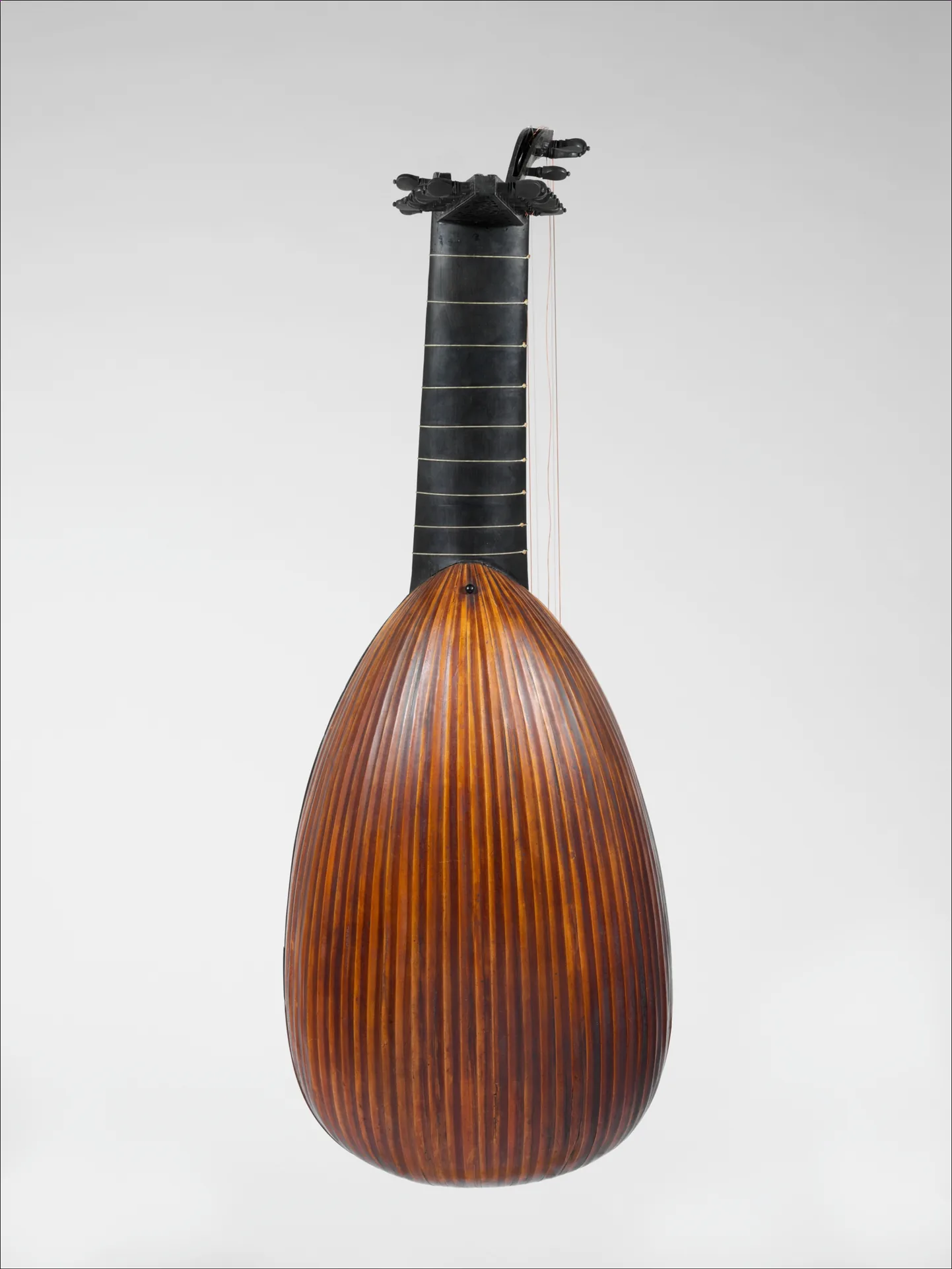
The lute: rounded back, pear-shaped body and bent-back pegbox
Its defining features include a rounded back made of ribs, a soundboard with a rosette and a bent-back pegbox. They make it easy to identify on stage.
The pear shape and depth of the body add warmth to the tone. The response of the strings gains richness, giving listeners a sense of closeness.
The large instrument: extended neck and physical balance
The very long neck extends to a second pegbox. The body is often larger to support the bass.
This changes the musician’s posture and the instrument’s balance. Its center of gravity shifts backward, requiring different support from the leg or strap.
Courses, single strings and comparison with the guitar
Many lutes use courses, or pairs of strings, to enrich the sound. Modern long-necked models, however, frequently use single strings.
Single strings offer greater clarity and make it easier to manage tension on a long neck.
The general playing position resembles that of a guitar, but the construction differs: the guitar has a flat back, the lute a rounded one, and lutes often have a shorter vibrating string length.
The plectrum’s legacy: finger playing predominates today, but some attacks and tone colors still derive from the earlier use of a plectrum.
Tunings and ranges: from the Renaissance lute to re-entrant tuning
Thinking of tuning as an architecture helps explain why certain pieces fall so naturally under the fingers.
Over the centuries, tuning systems evolved. Renaissance models supported polyphony through closely spaced finger positions. Variations in tuning were historically normal: they affected fingering, resonance and the overall tone.
On the larger instrument, re-entrant tuning is common: the first two high strings are lowered by an octave. The third string then becomes the highest, reducing the extreme upper range and enriching the bass.
This mechanical solution addresses a simple constraint: the long vibrating string length and increased tension make strings more fragile. The risk of breakage rises, especially during quick tuning changes.
Scordatura remains common for particular keys or pieces. It takes time in concert but offers new tone colors.
Listen for prominent open bass notes and lingering resonance. These clues distinguish playing centered on the bass strings from the more middle-register sound of a lute.
Playing techniques: right hand, fingers, nails and plectrum
The right hand shapes the balance between rhythm and tone. Finger playing relies on steady alternation: the thumb takes the bass, while the index and middle fingers play the upper voices. This technique makes the attack an essential part of expression.
Finger playing and the plectrum’s legacy
Historically, some phrasing imitated plectrum playing. Crisp attacks and articulations from that period can still be heard.
According to ResMusica, the playing gesture retains this memory. Players may therefore choose nails or fingertips according to the tone they want.
How thumb technique changed
In the sixteenth century, the thumb worked “inside” the hand to reproduce quill playing. Later, its position came closer to that used on the classical guitar.
Hand support and reference points
Dunford recommends resting the little finger on the soundboard for support. This reference point steadies the hand and helps control dynamics.
Campanella passages, broken chords and resonance
Campanella passages and broken chords use open strings to create lingering resonance.
Listen for wide arpeggios, bass notes played by the thumb and cascading resonance that distinguish a large instrument from a more compact model.
| Element | Function | Listening cue |
|---|---|---|
| Thumb | Bass notes, anticipation | Prominent open bass strings |
| Index and middle fingers | Voices, attacks | Clear passages and staccato |
| Little finger | Support, stability | Control of dynamics |
Frets, temperaments and intonation: a “living” instrument
An early instrument responds to its setup, the climate and string tension. These factors affect its intonation more than they do that of a piano with fixed tuning.
Gut frets are movable. Tied around the neck, they can slide. The musician moves them to adjust a historical temperament for a particular piece. This practice changes the “color” of the tuning.
Meantone temperament is a common choice. It favors certain keys, which sound very pure, while others require compromises. Players sometimes accept narrower seconds to obtain clearer thirds.
Vibrating string length affects intonation. On long necks, pressure from the left hand has a strong effect. The greater the string length, the more attack and tension alter the notes and their stability.
In practice, the musician checks the tuning regularly and between pieces. How the ensemble hears intonation depends on the continuo, the bowed strings and a shared sense of timing.
| Element | Function | Audible effect |
|---|---|---|
| Gut frets | Movable reference points | Adjustable temperament |
| Meantone temperament | Suited to certain keys | Purer thirds |
| Vibrating string lengths | Intonation stability | Effect of left-hand pressure |
Movable frets allow musicians to shape intonation for the piece and its period.
Notation and playing gesture: these choices help explain the value of tablature. It records how to play and makes adjustments easier when tuning conditions change during performance.
Reading and writing music for these instruments: tablature and continuo
Understanding tablature means following a map of how to play: the lines represent strings, and letters or numbers indicate positions. Tablature specifies which strings to pluck and where to place the fingers. It works well with variable tunings and fingerings specific to each instrument.
French and Italian tablature
The two systems share the same principle. Their conventions differ in how they notate diminutions, identify courses and represent broken chords.
Basso continuo
Basso continuo combines a staff with figures. The figures guide the harmony while the player realizes the chords in performance.
Modern notation and new music
In contemporary music, durations, harmonics and physical gestures are specified. The notation becomes more descriptive, and the performer adds annotations to the score.
- Practical example: in a concert, a player might perform a piece from tablature and then accompany an aria from figured bass.
- The performer helps shape the music through fingerings, tempo cues and adjustments to the instrument’s actual tuning.
For a deeper understanding of the historical teaching of basso continuo, this resource offers a practical reference.
Musical roles: soloist, accompaniment and orchestra
The musical role changes depending on whether the player performs alone, with a few musicians or in an orchestra. Three settings stand out: solo playing, chamber music and the opera pit.
The solo lute
Intimate polyphony: in solo music, the instrument brings out inner voices. Playing emphasizes contrapuntal detail and clear chords.
Its repertoire includes short pieces and suites, often designed to showcase a refined touch.
The solo theorbo
Bass and resonance: the larger model offers wide arpeggios and sustained bass notes. The playing gesture becomes broader, and resonance supports long phrases.
Accompanying voices and higher-pitched instruments
From colla parte playing to harmonization, the accompaniment changes according to the text and vocal range. ResMusica notes that these instruments can follow the vocal line or provide chords that color its sound.
Listening cues: the large instrument outlines the pulse without covering the voice; the lute highlights consonances in a smaller group.
“Subtle but indispensable”
- Coordination: continuo musicians share breathing and ornaments.
- Aim: to serve the style without prioritizing individual virtuosity.
Basso continuo in the Baroque: why the theorbo is “subtle but indispensable”
At the heart of the orchestra pit, basso continuo provides the framework on which the entire harmonic texture rests.
Continuo begins with a notated bass line and figures; its realization is then shared among the harpsichord, organ, viol, cello and a larger plucked instrument. Together, they establish the harmonic structure.
Foundation, pulse and support
The instrument’s role is to maintain the pulse and contribute to dynamic shading. The thumb establishes the harmony: it plays the bass notes, while the other fingers play the upper voices.
Its presence is often felt more than heard on its own. It articulates the dance rhythm, supports entrances and gives the ensemble confidence.
Improvisation within a framework
Improvisation follows clear constraints: inversions, diminutions and choices of texture follow the national style and the score. Within that framework, players ornament with taste.
Depending on the context—a recitative, chaconne or aria—the same bass line receives different realizations, adapted to the acoustics and the size of the ensemble.
| Function | Contribution to the sound | Practical cue |
|---|---|---|
| Harmonic foundation | Rounded bass notes and lingering resonance | Figures and shared realization |
| Pulse | Steady tempo | Thumb for the bass |
| Color | Articulation of dance rhythms | Variations to suit the piece |
Theorbo, archlute, chitarrone and angelique: an overview of the variants
Depending on its construction and use, the same name can cover very different instruments.
Archlute: second pegbox and open bass strings
The archlute is recognizable by its second pegbox, which holds long open bass strings. This arrangement creates deep drones that are especially useful in continuo.
A commonly cited tuning for this instrument is G–C–F–A–D–G. In concert, listen for the open bass notes that extend its resonance.
Chitarrone: the Italian name for the large model
In Italy, chitarrone refers to the large instrument with an extended neck. Italian workshops made substantial models for the emerging opera tradition.
The angelique in France: diatonic tuning and a smaller repertoire
Highly valued in the seventeenth century, the angelique is a small instrument with 17 single strings. Its diatonic tuning recalls the harp.
Its repertoire is more limited; it was used mainly for salon accompaniment and pieces from national traditions.
National differences in construction and tone
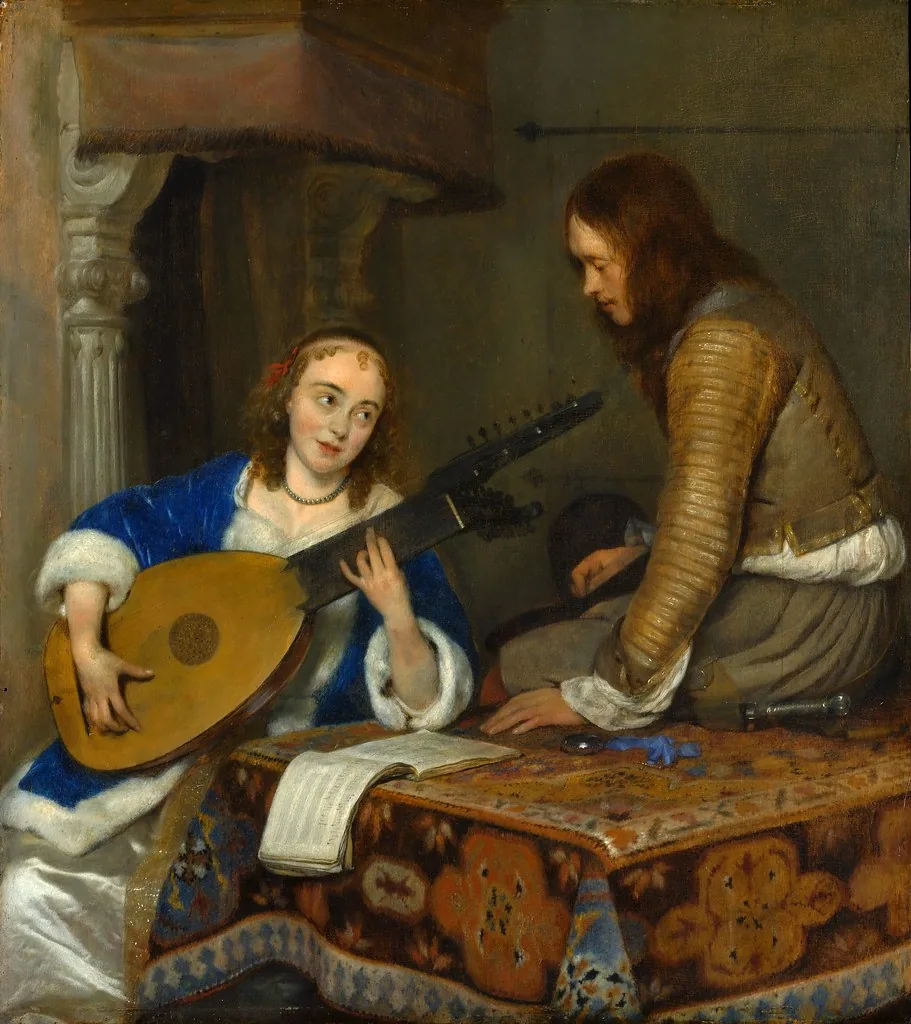
France, Italy and other traditions developed distinct preferences in body proportions, pegbox shape and string choice. Robert de Visée, at the court of Louis XIV, illustrates a French model closer to the lute than to the large Italian model.
| Feature | Archlute | Chitarrone and angelique |
|---|---|---|
| Pegbox | Double | Double and single, respectively |
| Neck length | Very long | Very long and short, respectively |
| Tone | Deep bass | Operatic and harp-like, respectively |
Repertoires: Renaissance and Baroque lute
From the eleventh to the seventeenth century, the sources reveal an abundant body of music for the instrument.
Scale and scope: according to ResMusica, the repertoire includes at least 30,000 pieces. This abundance explains the range of styles and the variety of performance practices today.
Composers and styles
Among the major figures, John Dowland embodies the Renaissance ideal, favoring polyphony and lyrical expression.
Silvius Leopold Weiss represents the Baroque high point, with richly harmonized suites and virtuosic writing.
Forms and practices
- Free preludes: often improvisatory, they establish an atmosphere.
- Dances (allemande, courante, sarabande, gigue): these call for rhythmic clarity and articulation.
- Suites and variations: these require careful handling of resonance and ornaments.
Ornaments, unequal notes and notation: practices differ among traditions—short ornaments in France, diminutions in Italy—affecting articulation and phrasing.
“A vast repertoire requires the performer to choose an aesthetic approach and adapt the resonance so that every note sings.”
| Period | Characteristics | Examples of pieces |
|---|---|---|
| Renaissance | Polyphony, dances, tablature | Air, pavane, courante |
| Early Baroque | Richer harmony, basso continuo | Suites, harmonic preludes |
| High Baroque | Virtuosity, complex suites | Variations, character pieces |
This vast repertoire also explains why the choice of instrument depends on the setting. In Baroque orchestral performance, range and resonance guide each instrument’s role.
Repertoires: the seventeenth-century theorbo, opera and experimentation
The seventeenth century marked the large instrument’s heyday: it became established in basso continuo while also gaining a distinct solo repertoire.
The large instrument in the seventeenth century: solo playing and continuo
In practice, it had two complementary uses. As a solo instrument, it offered broad arpeggios and dynamic contrasts. In continuo, it provided a harmonic foundation without covering the voice.
Writing tailored to the instrument: broken chords, sweeping gestures and open bass strings create distinctive colors. Rests leave space for the harmony to resonate.
Kapsberger and Castaldi: inventive playing gestures
Early seventeenth-century composers such as Kapsberger and Castaldi wrote highly experimental pieces. They explored new patterns, demanding fingerings and expressive uses of resonance.
In opera and the orchestra: color, support and space
On stage, the instrument colors recitative and shapes the musical dialogue. Its bass and resonance create a sense of space that complements the harpsichord and bowed bass instruments.
Practical cue: in an orchestra, players adjust the balance by reducing their volume and choosing chords that preserve vocal clarity.
This seventeenth-century inventiveness anticipated modern explorations of gesture and tone. It remains a source of inspiration for new music today.
The theorbo today: contemporary composition and new techniques
Contemporary composition takes this instrument into new territory in tone and gesture.
A living paradox: a revived early instrument faces modern demands, including long sustained passages, extreme dynamics and hybrid notation. Composers must account for technical constraints such as re-entrant tuning and the open extended bass strings.
Resonance depends strongly on materials. Gut strings respond differently from synthetic ones. Tension and the acoustics of the venue change the dynamic range and the choice of attack.
Approaches and new playing gestures
Players now explore harmonics, microintervals and combinations of open bass strings. Techniques borrowed from the harp, such as preparing a gesture and giving it a choreographic shape, help fill the musical space.
Notation and collaboration
Performer and composer often develop a piece together. Score annotations specify scordatura, pauses to retension a string or choices of arpeggio. Mulsant (Tiento), Fénelon (Lamento), Giraud (Caravaggio), Lang and Haddad are among those exploring the relationship between bass and continuo.
To bring these developments into your contemporary projects, allow time for trials, tuning adjustments and detailed discussion with the theorbist.
Choosing between lute and theorbo for your musical project
The choice between a short and a long neck often shapes the ensemble’s balance. For a voice-centered project—cantatas, airs or recitatives—the instrument with extended bass strings is often preferred for accompaniment and orchestral continuo.
Accompanying voices, playing in an ensemble or joining an orchestra: which instrument should you choose?
If your main aim is to accompany singers in a Baroque orchestra, prioritize bass depth and a steady continuo.
For chamber music and Renaissance or Baroque solo repertoire, choose the instrument that supports intimate polyphony and a delicate touch.
Ergonomics, neck length, string costs and regular practice
Neck length affects posture and fatigue. A large instrument requires a wider reach from the left hand and different support.
Long strings are more fragile, increasing string costs and maintenance needs. Regular practice helps stabilize tuning and intonation.
Studying in France: conservatory classes, courses and early music performance
Good news: access to teaching has expanded. Conservatories, regional conservatories, workshops and summer academies now offer specialist classes.
Hear the instruments in performance and talk to a luthier or teacher before buying. Try both and attend a continuo rehearsal to confirm your choice.
“Trying them in a real playing situation remains the best way to choose.”
| Project | Recommended choice | Reason |
|---|---|---|
| Vocal accompaniment and orchestra | Large instrument | Prominent bass, sustained support |
| Solo and chamber music | Compact instrument | Polyphony, intimate tone |
| Budget and maintenance | Assess string costs | More strings mean higher costs and a greater risk of breakage |
Conclusion
In summary, shape, range and playing technique determine how these plucked string instruments are used.
Shape: the larger instrument has a long neck with a second pegbox; the compact one has a short neck, rounded back and rosette. Range: deep bass for the first, middle and upper registers for the second.
Roles: one remains a pillar of continuo, subtle but indispensable according to ResMusica. The other shines in solo and chamber music. Their uses overlap depending on the piece.
Notation and tuning shape the learning process: tablature, basso continuo and re-entrant tuning affect fingerings and tone.
Hear the instruments in performance, try their playing positions with your project in mind, then consult teachers and luthiers in France to confirm your choice.